
Reviewed · WALKING TOURS
Aarhus Walking Tour: Explore Top Sights & Hidden Gems
Aarhus reveals itself best on foot, and this two-hour walk links its major sights with the small streets that give the city its character. You move from the grand Aarhus Theatre and cathedral into the Latin Quarter, then on to quiet Møllestien and Aarhus City Hall. It is a useful first look rather than a museum-heavy tour.
I like the easy pace and the compact route, especially if you have only one day in Aarhus or are visiting from a ship. I also like the mix of major landmarks and smaller streets, plus the chance to finish back at the starting point with a better sense of where to spend the rest of your day.
The main caution is group size. Up to 30 people may join, and one past group found it hard to hear the guide. The tour also may not include entry inside the theatre or cathedral, so check your expectations before booking.
Key points at a glance
- A two-hour introduction to central Aarhus: You cover major sights without giving up a whole morning or afternoon.
- A good old-and-new mix: The route pairs the cathedral and medieval streets with the civic architecture of Aarhus City Hall.
- Møllestien is the visual treat: Its narrow cobbled lane and colorful historic facades offer a welcome change from formal monuments.
- The walk is generally easy: One account describes it as a level route with no hills, though comfortable shoes still make sense on cobblestones.
- Guide quality matters here: Giulia, Julia, and Kim have all led tours praised for clear explanations, friendly service, and useful local tips.
- Large groups can affect the experience: With as many as 30 people, standing close to the guide is wise.
Why this Aarhus walk works for a first visit
At $39 per person, this is priced as a short orientation walk, not as a full-day cultural program. I think that is the right way to judge it. You are paying for a guide who gives the city shape, points out the main sights, and helps you decide what deserves a longer visit later.
The 10:00 a.m. start is useful. You can get an early look at the center, then use the rest of the day for a museum, shopping, lunch, or a return visit to one of the churches. If your time in Aarhus is limited to a single day, this walk gives you a practical map in your head.
The route also avoids the common mistake of showing only the postcard buildings. You get formal public architecture, religious sites, old lanes, and a lively shopping district. That variety helps you understand Aarhus as a working Danish city, not just a collection of monuments.
Guides have included Giulia, Julia, and Kim, with praise directed at their English, friendliness, pacing, and ability to explain the city. The exact guide is not guaranteed, but those names suggest the style you may encounter: a personal walk with room for questions rather than a silent march from one photo stop to the next.
A few more things to do in Denmark worth a look
- Private Walking Grand Tour of Copenhagen
★ 5.0 · 3,953 reviews - Copenhagen Highlights Walking Tour
★ 5.0 · 2,324 reviews - Politically Incorrect Private Highlights Walking Tour
★ 5.0 · 1,244 reviews
Starting at Aarhus Theatre
The meeting point is Aarhus Theatre, at Teatergaden 1. The theatre gives the walk a fitting start, since it introduces Aarhus as a cultural center before you head into the older part of town.
You are scheduled to spend about 20 minutes here. Expect an exterior look and an explanation of the building’s role in local performing arts. The theatre dates from the late 19th century and remains associated with productions ranging from classical plays to newer work.
This stop is useful even if you have no plan to attend a performance. Its central location makes it easy to find, and the building provides a clear starting marker for the group. You should arrive with enough time to locate the guide, since the meeting instructions have caused some confusion in the past. The guide may be identified by a yellow bag, but the description has not always been consistent, so keep the activity name and meeting point handy.
One practical point matters here: an exterior stop is not the same as a theatre visit. The information describes Aarhus Theatre as part of the route, but a past participant expected to go inside and found that disappointing. If indoor access is important to you, ask before the walk begins.
Aarhus Cathedral and the question of entry
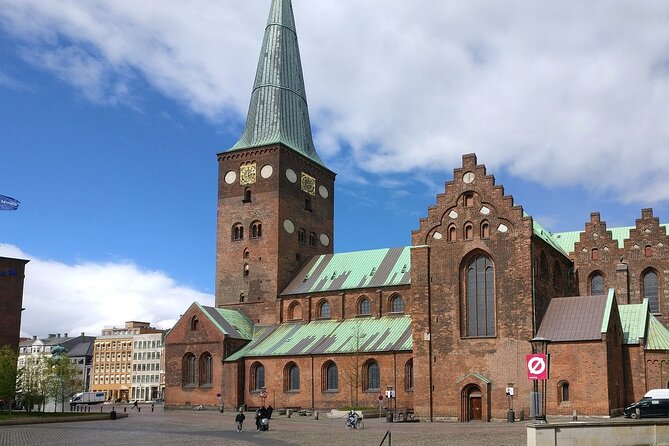
From the theatre, the route continues to Aarhus Cathedral, another approximately 20-minute stop. This is one of the city’s oldest major buildings, dating to the 12th century, and it gives the tour its clearest connection to medieval Aarhus.
A guide can help you read the building as more than a fine facade. The cathedral remains a place of worship and community life, so the visit has both architectural and present-day meaning. You will have time to look, listen, and ask questions rather than simply take a quick photograph from the pavement.
Again, do not assume that the stop guarantees an interior visit. The experience description presents the cathedral as a place on the route, while one participant specifically noted that the group did not go inside. Since churches can have services or other restrictions, the safest expectation is a guided exterior explanation unless the guide confirms entry.
That limitation does not make the stop pointless. The cathedral is central to Aarhus’s identity, and seeing it in context with the surrounding streets is valuable. Still, if you want to study the interior, arrange your own visit separately rather than counting on the walking tour.
The Latin Quarter: old streets with a modern pulse
The Latin Quarter receives another 20 minutes, and this is likely to be one of the most enjoyable parts for anyone who likes urban atmosphere. Narrow cobbled streets lead past cafes, shops, and galleries, with the area’s older buildings giving it a more intimate feel than the main civic spaces.
This is where the tour shifts from landmark viewing to street-level observation. You can see how older parts of Aarhus have adapted to present-day life. The guide may point out small details you would pass on your own, and the compact lanes make a good setting for questions about the city’s past and current culture.
I especially like this part for first-time visitors who want to know where to return after the tour. You may find a cafe or shop that catches your eye, but the walk itself is not designed as a shopping outing. Its purpose is to give you orientation and context.
The group size matters more in narrow streets. A group of 20 to 30 people can gather tightly around the guide, and one participant wanted headphones to make listening easier. If you have trouble hearing in crowds, stay near the front and tell the guide early. That small step could make the difference between following the story and catching only fragments.
Same base, a different kind of day out:
- Copenhagen: Canal Cruise with Guide
★ 4.6 · 9,115 reviews - Copenhagen: Hop-On Hop-Off Bus Tour with Boat Tour Option
★ 3.9 · 4,122 reviews - From Copenhagen: Lund and Malmö 2-Country Tour
★ 4.7 · 2,772 reviews - Copenhagen: Highlights 3 Hour Bike Tour with a Local Guide
★ 4.8 · 2,312 reviews
Our Lady Church and Aarhus’s older religious layer
The Church of Our Lady provides a second religious stop, with roots reaching back to the 12th century. Its inclusion gives the route more depth than a simple walk between the theatre and cathedral.
You get another view of Aarhus’s religious past, but the two churches need not feel repetitive. A good guide can explain their separate roles and place them within the development of the city. The stop also offers a quieter pause after the more active streets of the Latin Quarter.
The schedule allows about 20 minutes here. That is enough for an introduction, photographs, and questions, but not an extended architectural study. If you are fascinated by church interiors, plan extra time on your own and confirm opening access locally.
For me, the value of this stop lies in the way it broadens the story. Aarhus is not only a shopping center or university city. Its older churches help you see the layers beneath the modern streets.
Møllestien, the prettiest short stretch
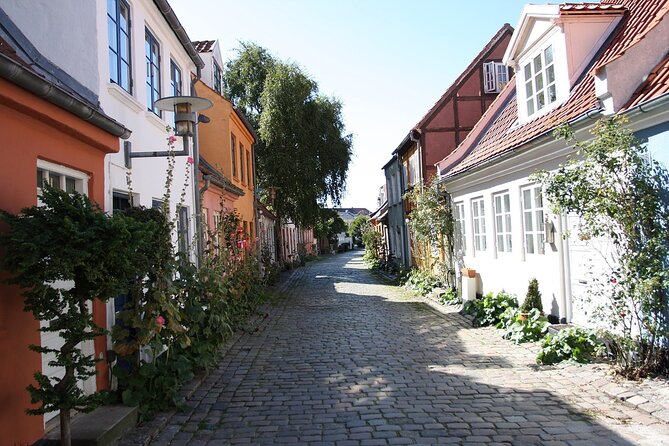
Møllestien is the route’s most immediately charming stop. This historic lane is known for cobblestones, narrow proportions, colorful facades, and preserved older buildings. It dates to the 18th century and feels more personal than the grander public buildings earlier in the walk.
You will spend about 20 minutes here, which should allow time to stroll, take photographs, and hear why the street matters. It is a good place to slow down. The lane shows how a small part of Aarhus can retain its old appearance while sitting close to the modern center.
Møllestien is also a reminder that a walking tour’s best moments do not always happen at the biggest monuments. The street itself is the attraction, and a guide can point out details about the buildings that are easy to miss when you walk alone.
Cobbles deserve a practical warning. The route is described as easy and without hills, but flat does not always mean smooth. Wear shoes you can walk in for two hours, especially if you plan to continue exploring after the tour.
Aarhus City Hall and the final surprises
Aarhus City Hall is the final named stop. The building adds a civic note to the route after the churches and older lanes. Its presence helps show the range of Aarhus architecture, from medieval religious buildings to modern public design.
About 20 minutes is allocated here, though the walk includes a few additional stops that are kept as surprises. That structure gives the guide some freedom to adjust the route and add places that fit the group’s pace or the day’s conditions.
One particularly appealing possibility is a finish at the top of Salling Department Store. A past walk ended there, with an outdoor cafe area and a view over the city. This is not promised as part of every tour, so treat it as a possible bonus, not a booking guarantee. If it happens, it gives you a useful final look at Aarhus from above and a natural place to plan the rest of your day.
The tour ends back at the meeting point near Aarhus Theatre. That makes logistics simple. You are not left across town trying to find your way back to your hotel or transport connection.
Guide style, group size, and sound quality
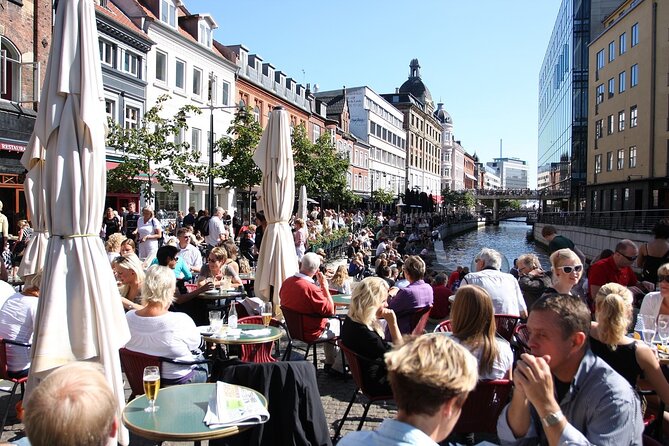
The strongest part of this experience is the guide. Giulia, Julia, and Kim have been singled out for friendly delivery, clear English, useful information, and a good sense of pace. One guide was especially appreciated for giving practical tips for spending the rest of the day, which is exactly what I want from a short city walk.
The feedback is not entirely uniform. A group of about 25 people found the guide difficult to hear and felt the presentation was weak. Another participant wanted headsets for large groups and more discussion of modern Danish life, including everyday culture and useful figures.
That tells you how to make the most of the tour. Stand close to the guide, ask questions when the group pauses, and speak up if you cannot hear. If you want a highly interactive walk focused on contemporary Danish society, say so early. The advertised route gives plenty of historical and architectural material, but the amount of cultural discussion may depend on the individual guide.
The maximum group size is 30. That is not enormous for a walking tour, but it is large enough to affect the experience in narrow streets and around busy sights. You should expect a shared group format, not a private walk.
Who should book this walk
I would choose this tour if you are visiting Aarhus for the first time, have only a few hours, or want a clear introduction before exploring alone. It is also well suited to a ship stop, since the two-hour length leaves time for independent plans afterward.
The route should work for most people, and one account describes it as an easy walk with no hills. Still, you will be outdoors for around two hours and may cross cobblestones. Service animals are allowed, and the meeting point is near public transportation.
This is less ideal if your top priority is entering every major building. The cathedral and theatre are included as sights, but indoor admission is not clearly guaranteed. It may also disappoint you if you need a quiet, small-group experience with individual attention.
At $39, the value depends on how much you use the orientation. If you follow the guide closely, note places to revisit, and ask for practical advice, the price is reasonable for a two-hour introduction. If you mainly want interior access or a private guide, you may prefer to spend that money elsewhere.
Free cancellation is available up to 24 hours before the 10:00 a.m. start. Changes or cancellations inside that window are not accepted for a refund, so keep the local cut-off time in mind.
Should you book the Aarhus Walking Tour?
Yes, if you want a friendly, efficient first look at the city and can accept a group walk. The route has a good balance: theatre, cathedral, churches, the Latin Quarter, Møllestien, City Hall, and a few extra stops. It gives you both the grand outline and some of the streets that make Aarhus pleasant to explore.
I would book it for a first morning in town, especially with limited time. Just keep expectations clear: the tour is an overview, not an indoor museum visit, and the guide’s audibility may depend on group size and where you stand.
Arrive ready to walk, position yourself near the guide, and ask about any building you hope to enter. With those simple precautions, this is a practical way to get your bearings and find the parts of Aarhus worth revisiting.
FAQ
How long is the Aarhus walking tour?
The tour lasts approximately two hours.
What time does the tour start?
The scheduled start time is 10:00 a.m.
Where does the tour meet?
The meeting point is Aarhus Theatre, Teatergaden 1, 8000 Aarhus, Denmark.
Where does the tour end?
The activity ends back at the meeting point near Aarhus Theatre.
Is the tour offered in English?
Yes. The tour is offered in English.
What sights are included?
Named stops include Aarhus Theatre, Aarhus Cathedral, the Latin Quarter, Our Lady Church, Møllestien, and Aarhus City Hall. There are also a few additional stops.
Does the tour include admission tickets?
The listed stops have no admission ticket cost, but entry inside Aarhus Theatre or Aarhus Cathedral is not guaranteed. A past participant specifically found that the group did not enter those buildings.
How many people can join the tour?
The maximum group size is 30 people.
Can I cancel for a full refund?
Yes, if you cancel at least 24 hours before the experience start time. Cancellations or changes made less than 24 hours before the start are not accepted for a refund.
Just added in Denmark
- a day at North Zealand Castle Tour★ 4.5 · 19 reviews
- Copenhagen Walking Tour: Highlights and Hygge w/Lunch★ 5.0 · 272 reviews
- Exhibition – Home of Carlsberg★ 4.5 · 281 reviews
- SUP – Stand Up Paddle – Kitesurfing – Wingfoil & Kitefoil courses★ 5.0 · 14 reviews
- The Six Forgotten Giants Trolls Hunt with Minibus★ 4.5 · 27 reviews
- The Hunt For The Six Forgotten Giants★ 5.0 · 45 reviews
- Politically Incorrect Private Hidden Gems Walking Tour★ 5.0 · 270 reviews
- Social Nightlife Crawl Copenhagen★ 5.0 · 164 reviews
Walking Tours, compared.

Reykjavik Food Walk – Local Foodie Adventure in Iceland
Read our review →
Reykjavík Small group Walking Tour – by CityWalk
Read our review →



Past & Present Small Group Guided Walking Tour
Read our review →
Walking Tour in Bergen of the Past and Present
Read our review →
Browse the lists this tour appears in