
Reviewed · OLD TOWN & HISTORIC QUARTER TOURS
Walking tour – Copenhagen Old Town & Tivoli Park included
Copenhagen’s best sights fit into a compact two-hour walk here, ending at Tivoli Gardens. You move from the royal heart of the city to colorful Nyhavn, old squares, the cathedral, and the famous amusement park without having to sort out the route yourself. Tivoli entry is included, which makes the finish especially handy.
I like the useful mix of landmarks and the way the tour works for a short visit or a cruise stop. I also like the modest group limit of 21 people, though actual group size can affect how personal the guiding feels. The main caution is pace and guide quality: some guides have been praised for warmth and storytelling, while others have walked too fast or seemed less prepared.
Key points before you book
- Tivoli is the finish: Stay in the park after the walk during its opening hours.
- The route covers central Copenhagen: See Kongens Nytorv, Nyhavn, Amalienborg, Rosenborg, the cathedral, old squares, City Hall Square, and Strøget.
- The Little Mermaid is not included: This tour focuses on the central old city instead.
- The changing guard may fit the schedule: Amalienborg’s ceremony takes place daily at noon, but ask how the day’s timing lines up.
- The group limit is 21: That is manageable, though not as intimate as a private tour.
- It is built for a short visit: The walk lasts about two hours and ends at Tivoli, not back at the starting point.
From Højbro Plads into Copenhagen’s old center
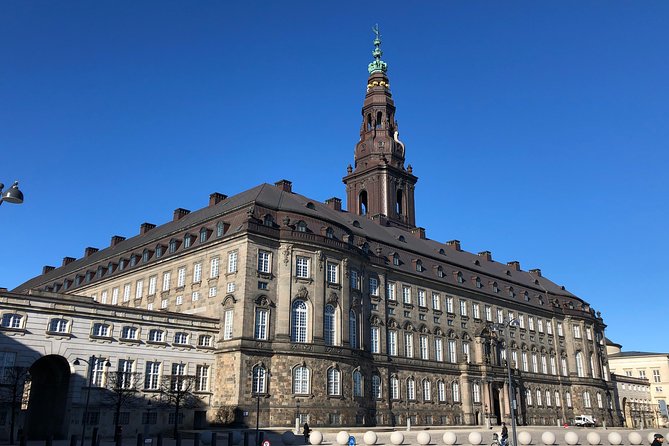
Meet at Højbro Plads at 10:00 a.m., a central spot near Copenhagen’s pedestrian core. This is a sensible starting point because you are already close to the old city, Strøget, and the squares that shaped Copenhagen’s growth.
The walk begins near Kongens Nytorv, or King’s New Square, laid out by Christian V in 1670. The square moved the center of Copenhagen away from the older marketplace at Gammeltorv and gave the expanding city a more formal, Paris-inspired plan. At its center is an equestrian statue of Christian V.
The buildings around the square help you read Copenhagen’s past without needing a museum visit. You see the Royal Danish Theatre, Charlottenborg Palace, the former Thott Palace, Hotel D’Angleterre, and Magasin du Nord. Each points to a different side of the city: royal power, art, diplomacy, grand hotels, and shopping.
This first stop is short, about 10 minutes, so expect an overview rather than an extended architectural lesson. That is fine for a first look. You will have more time to explore the square on your own later if one of its buildings catches your eye.
Other walks through old Copenhagen:
- Copenhagen: 2-hour Old Town Private Walking Tour
★ 4.3 · 64 reviews - Walking Tour of Stockholm Old Town
★ 5.0 · 1,175 reviews - The Original Stockholm Ghost Walk and Historical Tour – Gamla Stan
★ 4.5 · 1,165 reviews
Nyhavn gives you Copenhagen’s postcard moment
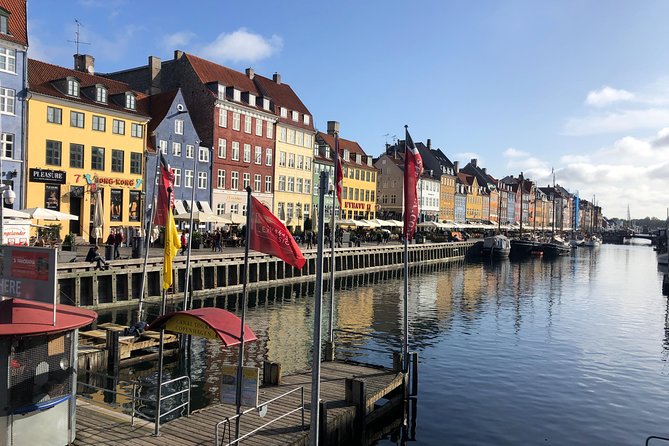
From the formal square, the route continues to Nyhavn. The canal, colorful façades, old ships, and waterside setting make this one of the easiest places in Copenhagen to recognize in photographs.
You spend about 15 minutes here. That is enough to take pictures, hear the basic story of the canal, and get a feel for the old waterfront, but not enough for a slow café stop or a detailed look at every building. If you want a drink or coffee, plan to return after the tour. Coffee and tea are not included.
Nyhavn can be crowded, and the narrow waterfront leaves little room for a large group to spread out. Stay close to the guide, especially when the commentary begins while people are still catching up. One past participant found that a guide walked ahead too quickly, making it harder for the group to hear everything. That is a useful warning on any walking tour, but especially here.
Amalienborg and the noon royal guard ceremony
Amalienborg Palace brings the route into the present-day royal city. The palace square is formed by four matching Rococo buildings around a statue of King Frederik V from 1771.
The four palaces have different roles. Christian VII’s Palace is used for visiting royalty, Frederik VIII’s Palace is associated with the Crown Prince’s family, Christian IX’s Palace is associated with the Queen, and Christian VIII’s Palace contains the museum open to the public. The royal family still uses the complex, so this is not simply a preserved monument.
The daily changing of the Royal Guard takes place at noon. The guards march from their barracks near Gothersgade by Rosenborg Castle through the streets before reaching Amalienborg. Seeing the ceremony can be one of the strongest moments of the morning.
There is one timing detail to check. The tour starts at 10:00 a.m. and lasts about two hours, while the guard change happens at noon. Since the exact order and pace of the walk can vary, ask the guide at the beginning if the route is intended to meet the ceremony. One particularly happy account praised the chance to see the changing guard, but you should not assume every departure will place you in the square at exactly the right moment.
Rosenborg adds a royal story without a long castle visit
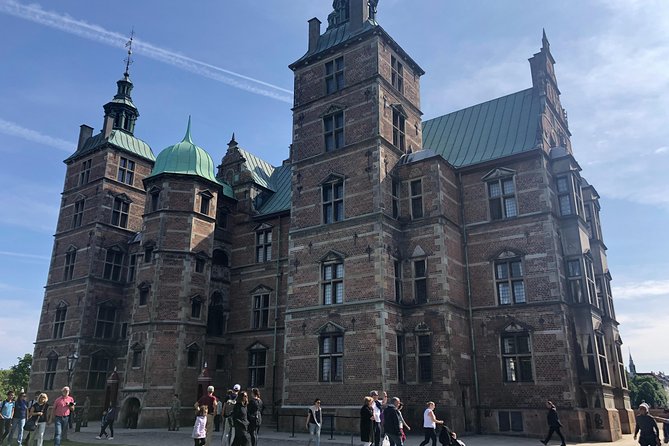
Rosenborg Castle is introduced as a Renaissance castle built in 1606 as a country summerhouse for Christian IV. Its location matters because the Royal Guard route passes by or begins near this part of the city before continuing toward Amalienborg.
The tour does not include a castle interior visit. That keeps the walk moving, but it also means you will not see the rooms or collections inside. If you have a strong interest in Danish royal objects, you will need separate time for the castle. For a first orientation, the outside context is useful: Copenhagen’s royal sights are close enough to connect on foot, yet each reflects a different period and purpose.
This is one place where the guide’s storytelling matters. A guide who links Christian IV’s building projects, Rosenborg, the guard route, and Amalienborg can make the city’s royal geography easy to understand. A less prepared guide may simply point out the buildings and move on.
A few more things to do in Copenhagen worth a look
- Private Walking Grand Tour of Copenhagen
★ 5.0 · 3,953 reviews - Copenhagen Highlights Walking Tour
★ 5.0 · 2,324 reviews - Politically Incorrect Private Highlights Walking Tour
★ 5.0 · 1,244 reviews - Copenhagen: Group Walking Tour – City Highlights – 2 Hours
★ 4.7 · 1,088 reviews
Church of Our Lady and Thorvaldsen’s sculptures

The Church of Our Lady, Copenhagen’s cathedral, brings a different kind of history to the walk. The current church was designed by C.F. Hansen in a Neoclassical style. Its foundation stone was laid by King Frederik VI in 1817, and it was consecrated in 1829.
The site goes much further back. A church has been present here since the era of Bishop Absalon, who is linked with the founding of Copenhagen. The original church was built around 1200 at one of the highest points in the medieval town.
The cathedral has also been tied to major Danish events. Margrethe I was married here in 1363, Søren Kierkegaard’s funeral took place here in 1855, and Crown Prince Frederik and Mary Donaldson married here in 2004.
Inside, Bertel Thorvaldsen’s sculptures of Christ and the apostles are the main artistic draw. Christ stands with open arms above the altar, while the apostles line the nave. Judas is represented by Paul. These sculptures are not a minor detail, so if they are high on your list, say so clearly at the start.
The cathedral was badly damaged during the British bombardment of Copenhagen in 1807, when an incendiary rocket struck the building. That event helps explain why the present church is a nineteenth-century reconstruction rather than a surviving medieval interior.
There is a practical concern here. Opening access can vary, and one past party arrived on a Sunday when the church was not yet open during the scheduled walk. If seeing the sculptures is important to you, confirm the day’s access with the guide and consider returning after the tour. The walk may pass the church, but it cannot control opening hours.
Gammeltorv, Nytorv, and the city’s rebuilding
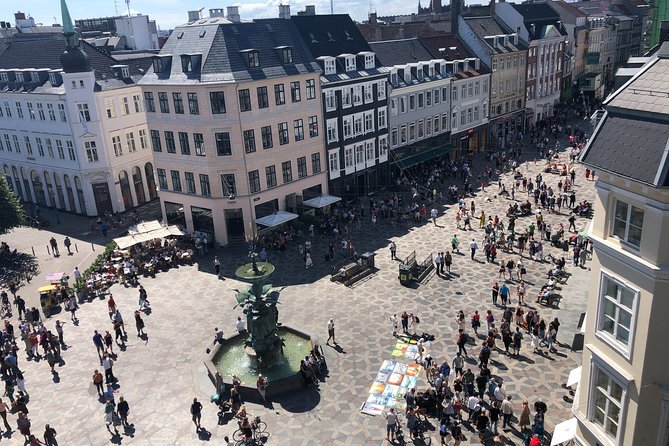
The route continues through Gammeltorv, Copenhagen’s oldest square, and adjoining Nytorv. Together they form a broad public space along Strøget.
Gammeltorv dates to the foundation of the medieval city, but much of what you see today came after the Great Fire of 1795. The rebuilt façades are mainly Neoclassical, giving the square a more orderly appearance than its medieval origins might suggest.
Look for the Caritas Well, a Renaissance fountain commissioned by Christian IV in 1610. It is an easy detail to miss if the group moves quickly, so this is another good moment to stay near the guide.
Nytorv is dominated by the old Copenhagen Court House. From 1815 to 1905, the building also served as City Hall. These squares are valuable because they show how Copenhagen changed after fire, war, and rebuilding. You are not just ticking off pretty buildings. You are seeing how the city repeatedly reshaped itself.
City Hall Square and the final walk along Strøget

Rådhuspladsen, or City Hall Square, is the last major urban stop before Tivoli. It is broader and more open than the older squares, with Copenhagen’s City Hall forming the main visual focus.
The square helps mark the change from the old center to the newer city around Vesterbrogade. It is also a practical orientation point. From here, Tivoli is close, and the tour’s final stretch leads toward the park entrance.
Strøget is Copenhagen’s car-free shopping street and one of Europe’s longest pedestrian shopping streets, running about 1.1 kilometers through the center. The route uses it as a link between the old city and City Hall Square. You will see a mix of shops, historic façades, side streets, and crowds.
This part is useful if you are staying in central Copenhagen because it shows where to return for shopping or an easy walk. It is less satisfying if you want quiet lanes or a long stop at each landmark. The appeal is orientation and coverage, not solitude.
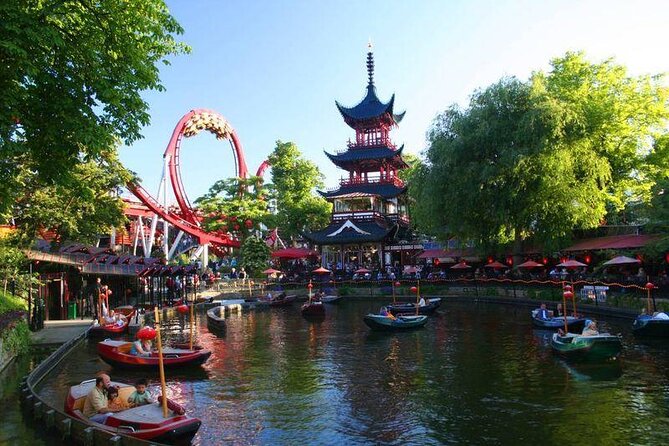
Tivoli Gardens makes the ending practical
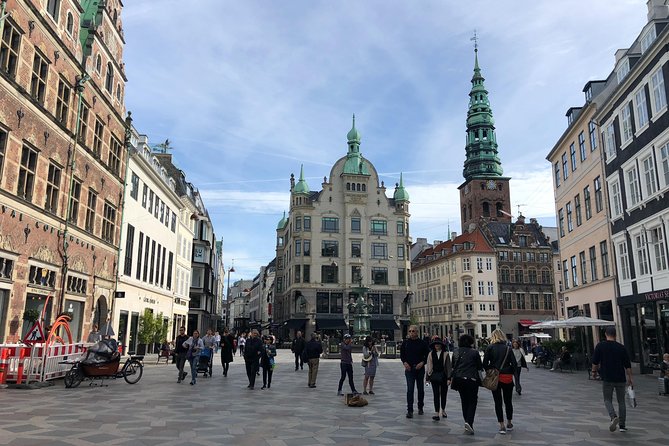
The tour ends at Tivoli’s entrance on Vesterbrogade. The guide explains the park’s history and brings you to the entrance, where your general admission is included for visitors aged eight and older.
The practical advantage is simple: you do not have to buy a separate entrance ticket at the end of the walk, and you can stay in Tivoli as long as you wish within the park’s opening hours. This makes the tour a good fit for someone who wants a morning introduction followed by an afternoon or evening at one of Copenhagen’s best-known attractions.
The entry ticket is not the same as a guided visit through the park. After you are checked in, you are free to explore on your own. One past participant felt the guide did little to explain Tivoli beyond getting the group through the entrance, while another considered the gardens a clear highlight. I would treat Tivoli as a self-guided second half of the day, not as another extended guided tour.
Because the park is the final stop, this tour does not return you to Højbro Plads. That is convenient if Tivoli is your plan, but less convenient if you need to collect luggage or meet transport back at the starting point.
How the guiding can shape the morning
The strongest praise has focused on guides who combine facts with stories and allow time for photographs. Felipe was described as pleasant and informative, while Viviane was praised for explaining each stop and answering questions. Other accounts describe guides who were patient with a wheelchair user and adjusted the route to the group’s needs.
There have also been uneven reports. One guide, Vasco, was criticized for not introducing himself, starting commentary before everyone had caught up, and walking too quickly. Another guide had trouble retrieving the Tivoli tickets and did not explain the park in much detail. A separate complaint concerned a guide who needed a translation app for Danish signs and was uncertain about the cathedral’s sculptures.
The provider has also identified Kim as a Danish guide with several years of experience, so guide assignments clearly vary. I would ask the guide’s name at the meeting point and tell them your priorities early: the guard ceremony, Thorvaldsen’s sculptures, photographs, wheelchair needs, or a slower pace. That small conversation may help shape the morning.
Price, pace, and who gets good value
At $79.30 per person, this is not the cheapest way to walk through Copenhagen. The value comes from combining a guided city introduction with Tivoli’s general entrance fee and a route that covers a lot in two hours.
I think the price makes the most sense in three situations. First, you have only a short time in Copenhagen and want a quick orientation. Second, you want to visit Tivoli anyway and appreciate having the entry arranged. Third, you prefer a guide to handle the route while you listen and take photographs.
The value is weaker if you already know the central city, prefer to walk at your own speed, or mainly want an in-depth visit to the cathedral or royal palaces. Several sights are viewed from outside, and two hours leaves little room for lingering.
The group maximum is 21 people. That is small enough to be workable, but it is not a private experience. Most travelers can participate, and the route is near public transport. Still, Copenhagen’s cobblestones, crowds, and brisk city walking can matter if you have mobility concerns. Tell the guide at the start if someone in your party needs a slower pace.
The tour averages being booked 52 days ahead, so advance planning may be sensible during busy periods. Free cancellation is available until 24 hours before the start time. If the minimum number is not reached and the operator cancels, you are offered another date or a full refund.
Should you book this Copenhagen walk?
Book it if you want a fast, organized introduction to central Copenhagen and plan to spend time at Tivoli afterward. The route gives you royal squares, Nyhavn, old markets, the cathedral, City Hall Square, and Strøget in one morning, with no need to study a map.
I would book with two requests in mind: ask about the noon guard ceremony, and confirm whether the Church of Our Lady will be open when you arrive. If the cathedral sculptures are essential, plan a return visit.
Skip it if you want a slow, highly personal walk or a guaranteed specialist guide. The best departures appear to depend heavily on the individual guide. At its best, this is a useful city primer with a fine Tivoli finish. At its weakest, it can feel like a brisk checklist that you could manage with a map.
FAQ
Where does the tour start?
It starts at Højbro Plads, Højbro Plads, 1200 København, Denmark.
What time does the walking tour begin?
The scheduled start time is 10:00 a.m.
Where does the tour end?
It ends at Tivoli Gardens, at Vesterbrogade 3, 1630 København V, Denmark. You may stay in the park after the tour during its opening hours.
Is Tivoli Gardens admission included?
Yes. General Tivoli Park admission is included for visitors aged eight and older.
Is The Little Mermaid included?
No. The tour covers central Copenhagen landmarks but does not include The Little Mermaid.
Is the tour offered in English?
Yes. The experience is offered in English and uses a mobile ticket.
How far in advance can I cancel?
You can cancel up to 24 hours before the start time for a full refund. Changes or cancellations made less than 24 hours before the start are not accepted for a refund.
Just added in Copenhagen
- a day at North Zealand Castle Tour★ 4.5 · 19 reviews
- Copenhagen Walking Tour: Highlights and Hygge w/Lunch★ 5.0 · 272 reviews
- Exhibition – Home of Carlsberg★ 4.5 · 281 reviews
- The Six Forgotten Giants Trolls Hunt with Minibus★ 4.5 · 27 reviews
- The Hunt For The Six Forgotten Giants★ 5.0 · 45 reviews
- Politically Incorrect Private Hidden Gems Walking Tour★ 5.0 · 270 reviews
- Social Nightlife Crawl Copenhagen★ 5.0 · 164 reviews
- THE TUBE – Copenhagen: an immersive Experience★ 4.0 · 124 reviews
Old Town & Historic Quarter Tours, compared.

The Original Stockholm Ghost Walk and Historical Tour – Gamla Stan
Read our review →

Walking Tour of Stockholm’s Old Town, Gamla Stan
Read our review →

Old Town Guided Walking Tour (English / Deutsch)
Read our review →
Secrets of Gamla Stan Guided Tour w/ Fika Option
Read our review →
Browse the lists this tour appears in