
Reviewed · WALKING TOURS
2-Hour Walking Introduction to Copenhagen and its Main Sights
Copenhagen’s story comes into focus on foot, one square and palace at a time. This two-hour walk links City Hall Square, Christiansborg, Nyhavn, and Amalienborg, giving you a useful first look at how the Danish capital grew from a medieval settlement into a modern royal and political center. The route is packed, but it is not just a checklist of sights. Guides explain the people, power struggles, customs, and odd little details behind the buildings.
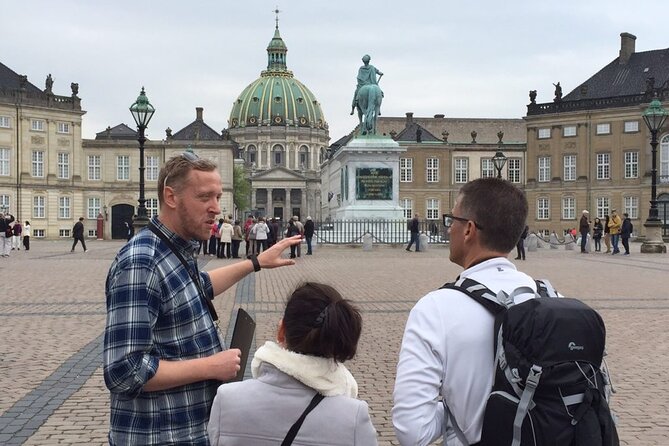
I like the small group of no more than 10 and the chance to ask direct questions. I also like the practical finish: the guide points you toward more sights, food, bakeries, and ways to continue exploring. The main drawback is pace. You cover a lot in two hours, so this is an orientation walk rather than a slow architectural study, and the route may feel demanding in poor weather or heat.
Key points to know before booking
- City Hall to Amalienborg: The walk connects central Copenhagen with the royal quarter in roughly two hours.
- Stories, not just buildings: Guides cover Denmark’s rulers, parliament, the navy, local customs, and Copenhagen’s growth.
- Small-group format: A maximum of 10 people makes questions and conversation easier.
- Clear English commentary: Headsets are available so you can follow the guide in busy areas.
- Strong first-day value: The map and follow-up suggestions help you plan the rest of your stay.
- Outdoor focus: Castles and museums are seen from outside, with no admission included.
Why this works well as your first Copenhagen walk
The best use of a short city tour is to help you understand where everything sits. This one does that well. You begin at City Hall Square, cross the historic center, reach the government quarter, pass the old harbor, and finish near the royal palace. By the end, you have a mental map of central Copenhagen instead of a collection of disconnected photographs.
The guide also gives you a feel for Danish identity. The stories cover war, monarchy, politics, religion, trade, and everyday life. That mix matters because Copenhagen can look polished and orderly at first glance, but its character comes from centuries of rivalry, rebuilding, and practical adaptation.
The English-speaking guides are a major part of the experience. Jens is repeatedly described as especially lively and well informed, with personal links to Copenhagen reaching back several generations. Rasmus has led especially personal walks, including one private outing when only two people booked. Nick is noted for adding personal perspective and helping with extra plans beyond the standard route. Other guides, including George and Thomas, have also led the walk.
You should not expect one fixed personality every day. The guide can change, but the common thread is a strong grasp of Danish history and a willingness to answer questions. That makes the tour better for people who enjoy conversation than for those who prefer a silent stroll and a printed script.
A few more things to do in Copenhagen worth a look
- Private Walking Grand Tour of Copenhagen
★ 5.0 · 3,953 reviews - Copenhagen Highlights Walking Tour
★ 5.0 · 2,324 reviews - Politically Incorrect Private Highlights Walking Tour
★ 5.0 · 1,244 reviews
City Hall Square and the center of modern Copenhagen
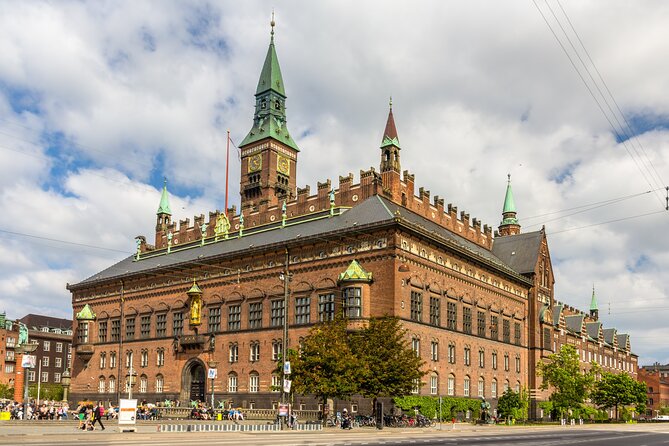
The walk begins beside the statue of Hans Christian Andersen at City Hall Square. This is one of Copenhagen’s main gathering places, especially when Danes celebrate major sporting victories or other national events. It is a useful starting point because you are immediately in the middle of civic Copenhagen, surrounded by traffic, public buildings, shops, and routes leading into the old town.
The city hall itself was built in 1905 and remains the administrative home of Copenhagen. The guide uses the square and the building to explain how the city works today, while also pointing back to earlier chapters of its past.
From here, the route passes Tivoli Gardens. The amusement park is famous for its location in the middle of a major city, and even seeing it from outside helps explain Copenhagen’s unusual blend of public life, entertainment, and historic streets. You do not enter Tivoli on this tour, so allow separate time and an admission fee if you want the rides, gardens, or evening atmosphere.
The walk also reaches Strøget, one of the world’s longest pedestrian shopping streets. This is not simply a shopping stop. It shows how the old center functions as a modern city corridor, linking major squares while keeping much of the area pleasant for walking.
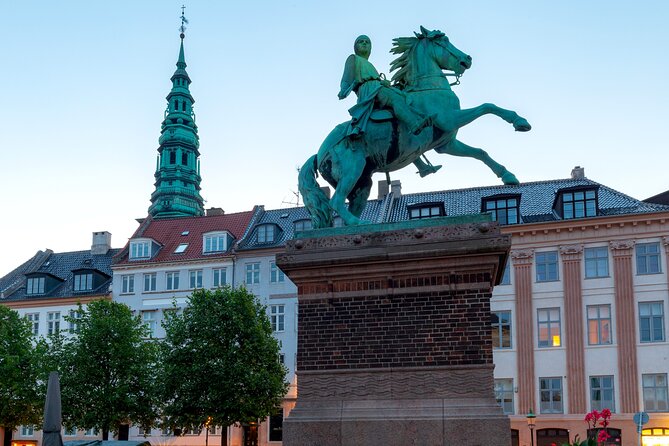
A statue of the bishop associated with Copenhagen’s founding in 1189 adds an early chapter to the story. These brief stops are not long enough for detailed study, but they give you a chronological thread: medieval beginnings, royal power, civic government, and present-day city life.
Christiansborg and the machinery of Danish power
Christiansborg Palace is one of the strongest stops on the route. Denmark’s parliament, supreme court, and prime minister all have a home here, making the palace more than a royal monument. It is a working center of national government.
The guide explains that Copenhagen was founded at this site. That fact gives the square more weight than its impressive stonework alone. You are looking at the place where the city’s political story took shape, then continued through royal rule, constitutional government, and modern administration.
From Christiansborg, the guide can point out ministries, the central bank, and other important buildings. This is where the tour earns its price for first-time visitors. A map may show you the palace, but a guide can explain why the surrounding streets matter and how the city’s institutions fit together.
You do not go inside Christiansborg as part of the walk. That keeps the tour moving, but it also means you should add a separate visit if you want palace rooms, government interiors, or museum exhibits. The tour gives you context first, which can make a later indoor visit easier to appreciate.
The harbor, Christian IV, and Copenhagen’s naval past
At Christian IV’s Brewhouse, a huge brick building from 1618, the route shifts from government to maritime power. The building sits by the harbor and opens a discussion about Copenhagen as a naval base during the Renaissance.
This is one of the more useful historical contrasts on the walk. Copenhagen is now associated with bicycles, design, restaurants, and relaxed public spaces. The harbor once had a much harder military purpose. The guide explains how ships, supplies, and royal power were tied together in this part of the city.
Admission to the brewhouse is not included, and the walk does not turn into an interior museum visit. You see the building and hear its story from outside. That is enough for a brief introduction, though history fans may want to return later for more time around the harbor.
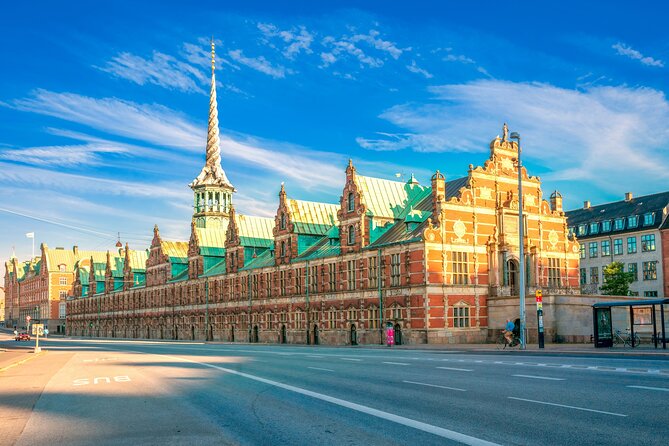
Nearby, the old stock exchange adds another memorable detail. Its tower is formed by the tails of three dragons, a distinctive piece of Copenhagen architecture from the early 1600s. This is exactly the sort of feature that is easy to miss if you walk alone with a general map. The guide turns a strange rooftop shape into a story about trade, ambition, and the visual language of old Copenhagen.
Same base, a different kind of day out:
- Copenhagen: Canal Cruise with Guide
★ 4.6 · 9,115 reviews - Copenhagen: Hop-On Hop-Off Bus Tour with Boat Tour Option
★ 3.9 · 4,122 reviews - From Copenhagen: Lund and Malmö 2-Country Tour
★ 4.7 · 2,772 reviews - Copenhagen: Highlights 3 Hour Bike Tour with a Local Guide
★ 4.8 · 2,312 reviews
Holmens Kirke and the royal side of the city
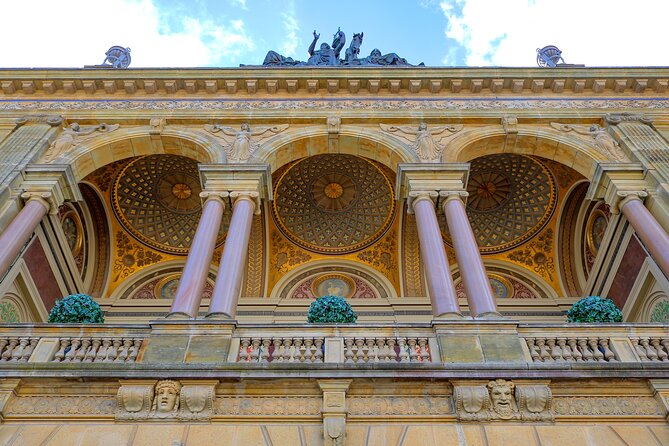
Holmens Kirke dates from the 1500s and remains tied to the country’s ruling class. Prime ministers are buried there, and royal weddings have taken place inside. If church activities allow, the group goes in for a short visit.
The qualification matters. This is an active church, not a sightseeing set piece, so interior access is not guaranteed. If you enter, keep the stop short and respectful. If the church is closed, the exterior and the guide’s explanation still fit neatly into the larger story of religion, government, and monarchy.
The church also gives the tour a quieter pause after the broad spaces around Christiansborg and the harbor. You are still in the historic center, but the focus narrows to ceremony, memory, and national tradition.
Kongens Nytorv and the road to Nyhavn
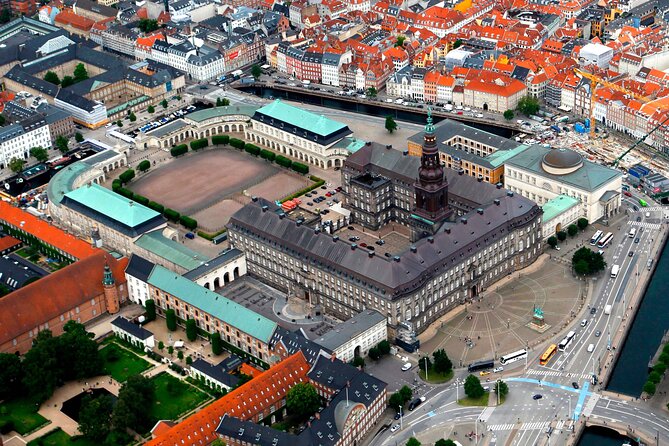
Kongens Nytorv, or King’s New Square, is one of the city’s grandest open spaces. It was laid out during the Renaissance and later surrounded by impressive 1700s buildings. The square is a natural point for the guide to explain how Copenhagen expanded beyond its older medieval core.
The route description treats this as the point where the main walk ends, with advice on continuing toward Nyhavn, Amalienborg, and the Little Mermaid. The listed route also includes Nyhavn and Amalienborg, and the stated endpoint is Amalienborg Palace. In practical terms, you should expect guidance for this final section and confirm the exact day’s finish with your guide.
That small ambiguity is worth knowing before you book. If you need to leave precisely at the two-hour mark, ask where the group will finish. If you have time, continuing toward the harbor and palace makes good sense, since both are among Copenhagen’s most recognizable sights.
Nyhavn and the colorful harbor view
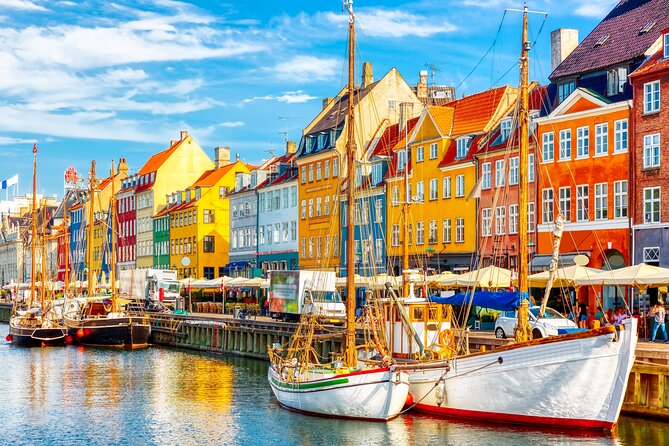
Nyhavn is the postcard stretch of Copenhagen, with colorful houses lined along the water. The canal was dug in the 1600s by Swedish prisoners of war, a detail that adds a sharp edge to an otherwise cheerful-looking scene.
The stop is free and outdoors. You get the classic waterfront view, along with a quick explanation of how the canal was made and why it mattered. It is also a sensible point for a short pause. One walk took a brief rest in Nyhavn during hot weather, which is useful to remember if you visit in summer.
Do not expect a meal or pastry tasting to be built into the tour. Some people would enjoy a planned bakery stop, but food is not included. The guide may offer suggestions, and specific recommendations have included Hart bakery and La Glacé for cakes and hot chocolate. Treat those as follow-up ideas rather than part of the booked experience.
Amalienborg and the royal finish
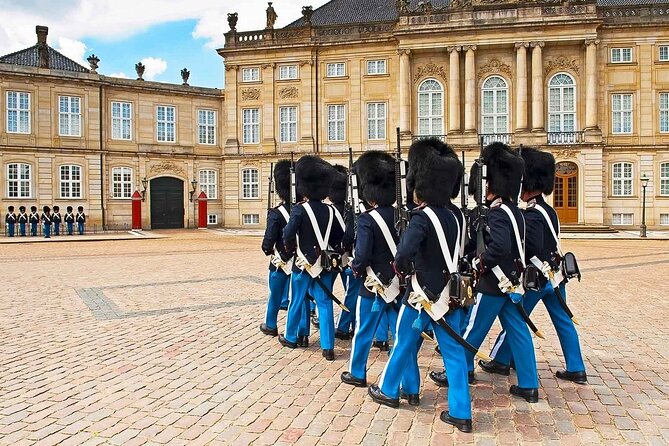
Amalienborg Palace is the final major sight. The royal family lives in four large mansions arranged around the square, creating one of Copenhagen’s most memorable architectural settings.
The guide connects the palace to dramatic events during World War II and explains its place in Denmark today. You see the royal residence from outside, but entry is not included. If you want palace interiors, plan a separate visit and budget for admission.
The timing can add an unexpected bonus. Several walks have ended near the changing of the guard, and one group saw the king drive past on his way to open Parliament. These moments cannot be promised, but the route is well placed for royal ceremonies when the schedule lines up.
The guide also explains how to reach the Little Mermaid and other sights after the walk. That is a practical benefit. You are not simply dropped at a final monument with no idea what comes next.
What you receive for $40.41
At $40.41 per person, the tour is priced above a casual self-guided walk but below a full-day private guide. The value comes from the combination of route, explanation, and personal advice.
You receive:
- A two-hour guided walk
- A small group capped at 10 people
- An English-speaking local guide
- A headset, which is optional but useful near traffic or in crowded areas
- A small city map
- Answers to questions during the walk
- Suggestions for more sights and directions for reaching them
For a first day in Copenhagen, that is a solid package. You can use the walk to decide which places deserve a return visit, rather than spending your limited time guessing from a map.
The value is lower if you already know central Copenhagen well or plan to visit only indoor attractions. Since the castles and museums are not entered, you are paying for orientation and interpretation, not admission. I would book it early in a visit, when the advice can shape the rest of your plans.
Pace, group size, and practical details
The meeting point is by the Andersen statue at City Hall Square, Rådhuspladsen, in central Copenhagen. The end point is listed as Amalienborg Palace, although the route information also describes Kongens Nytorv as a point where the guide explains how to continue. Check the final stopping point when you meet.
The tour is offered in English and is suitable for most people. You should be ready to walk for about two hours, with several short stops. The total duration includes movement between sights, so this is not two hours of standing at one monument.
A headset is supplied, though you do not have to use it. That is helpful if you want to stay at the edge of the group or have trouble hearing in busy streets. The small group makes it easier to ask about food, neighborhoods, royal customs, or other places you want to see.
The tour requires good weather. If poor weather forces cancellation, you can choose another date or receive a full refund. Free cancellation is available up to 24 hours before the start time. Public transportation is nearby, and confirmation is provided at booking.
Who should book this walk?
I would choose this tour if you are visiting Copenhagen for the first time, arriving with only a rough plan, or staying for a short time. It gives you the city’s basic structure quickly and leaves you with practical next steps.
It is also a good fit if you prefer history told through personal stories rather than a long formal lecture. Guides such as Jens have been praised for humor and family connections to Copenhagen, while Nick has been noted for helping shape extra plans when the standard route did not match a visitor’s needs.
You may want something else if you dislike walking, need guaranteed indoor access, or want a slow photography tour. The route covers ground, and the sights are mainly viewed from outside. Hot weather, rain, and crowded streets can make the pace less comfortable.
Should you book the Copenhagen introduction walk?
Book it if you want a lively first orientation with real historical context, a manageable group, and useful advice for the rest of your stay. The strongest reason is not simply the number of monuments. It is the way the walk connects city hall, royal power, trade, religion, the harbor, and modern Copenhagen in one clear route.
Skip it if you already know the center or want to spend two hours inside palaces and museums. For most first-time visitors, though, $40.41 buys a sensible start, especially when the guide is engaging and the small group leaves room for questions.
FAQ
How long does the Copenhagen walking tour last?
The tour lasts approximately two hours, including the time spent walking between stops.
What language is the tour offered in?
The tour is offered in English with a local English-speaking guide.
Where does the tour start?
It starts at the statue of Andersen in City Hall Square, at Rådhuspladsen, 1553 København V, Denmark.
Where does the tour end?
The listed endpoint is Amalienborg Palace at Amalienborg Slotsplads, 1257 København K, Denmark. The route information also describes Kongens Nytorv as a point where the guide explains how to continue toward Nyhavn, Amalienborg, and the Little Mermaid.
How many people can join the walk?
The group has a maximum of 10 participants.
Are palace and museum admissions included?
No. The walk does not include entry into castles or museums. You can visit them separately after the tour.
Is entry to Holmens Kirke guaranteed?
No. The group enters Holmens Kirke only if it is open and church activities allow it.
Is Nyhavn included in the walk?
Nyhavn is included among the route’s featured stops, with time to see the colorful harbor and learn about its origins.
Are headsets provided?
Yes. A headset is provided so you can hear the guide, though using it is optional.
What happens if the weather is poor?
The experience requires good weather. If it is canceled because of poor weather, you are offered a different date or a full refund.
Just added in Copenhagen
- a day at North Zealand Castle Tour★ 4.5 · 19 reviews
- Copenhagen Walking Tour: Highlights and Hygge w/Lunch★ 5.0 · 272 reviews
- Exhibition – Home of Carlsberg★ 4.5 · 281 reviews
- The Six Forgotten Giants Trolls Hunt with Minibus★ 4.5 · 27 reviews
- The Hunt For The Six Forgotten Giants★ 5.0 · 45 reviews
- Politically Incorrect Private Hidden Gems Walking Tour★ 5.0 · 270 reviews
- Social Nightlife Crawl Copenhagen★ 5.0 · 164 reviews
- THE TUBE – Copenhagen: an immersive Experience★ 4.0 · 124 reviews
Walking Tours, compared.

Reykjavik Food Walk – Local Foodie Adventure in Iceland
Read our review →
Reykjavík Small group Walking Tour – by CityWalk
Read our review →

Past & Present Small Group Guided Walking Tour
Read our review →
Walking Tour in Bergen of the Past and Present
Read our review →
Browse the lists this tour appears in