
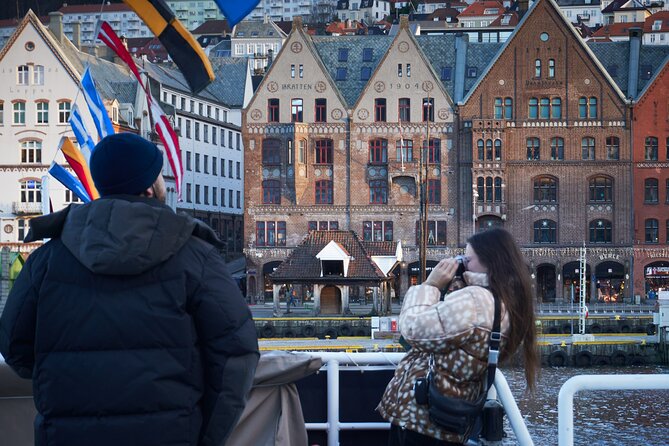
Reviewed · CRUISES & BOAT TOURS
Bergen City Cruise
Bergen’s story is easiest to understand from the water. From your seat on this one-hour harbor cruise, you look back at the old wharf, churches, fortifications, wooden homes, shipyards, and modern neighborhoods in one broad sweep. You also reach places that make little sense on a city walk, including the submarine bunker at Laksevåg and the old waterfront districts beyond Bryggen.
I like two things here. First, the cruise gives you a quick orientation to Bergen’s harbor before you spend time on foot. Second, it is an easy outing for mixed-age groups, with indoor seating, blankets in chilly weather, and access for most visitors, including wheelchair and stroller users. The main caution is the narration: it may be live captain commentary or a recorded broadcast, and sound quality can vary, especially if you want to sit outside.
Key points to know before you book
- One hour on the harbor: A short, useful introduction that fits neatly into a busy Bergen day.
- Bryggen from the water: You get a clean view of the famous Hanseatic wharf without the crowds found along the waterfront.
- More than the city center: The route reaches Skuteviken, Sandviken, Laksevåg, Nordnes, and the Byfjorden.
- History with a darker edge: WWII ruins and the submarine bunker add important context beyond Bergen’s pretty wooden facades.
- Good for families and older visitors: You can sit, stay warm, and see a lot without climbing Bergen’s hills.
- Price and timing: At $28.97 per person, it is reasonable for a one-hour boat ride, but the value depends on clear weather and working audio.
Why Bergen is best understood from the harbor
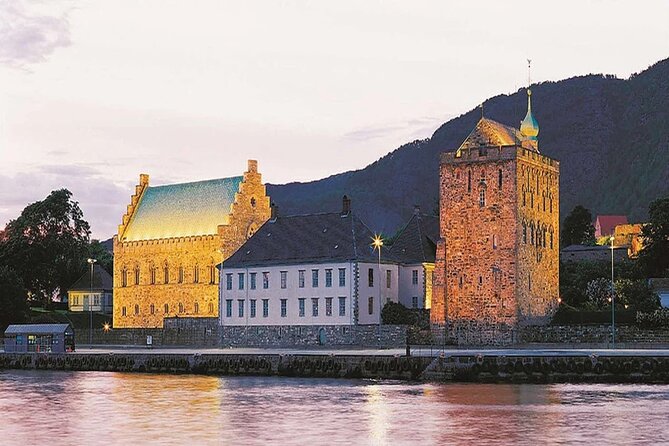
Bergen grew around Vågen, the sheltered inlet at the center of town. The water was the city’s highway, workplace, trading floor, and defensive line. A cruise gives you the view that merchants, sailors, soldiers, and fishermen once had every day.
From the boat, Bryggen appears as part of a larger waterfront story. The colorful wooden buildings are the famous image, but the surrounding fortifications, churches, warehouses, shipyards, and islands explain why this location mattered for centuries.
This is not a fjord cruise into dramatic mountain country. It is a city sightseeing ride on Bergen’s harbor and nearby waters. You come for architecture, local history, and a different angle on the city, not for a long voyage through remote scenery.
The boat departs from Strandkaien 11, close to the central harbor and the Fish Market. The activity returns to the same meeting point, so you do not need to arrange a separate ride back. A mobile ticket keeps the arrival simple, although it is wise to reach the pier early because a few departures have involved confusion about the exact pickup point.
A few more things to do in Bergen worth a look
- Bergen: City Tour on Foot
★ 4.9 · 1,327 reviews - Bergen: City Sightseeing Hop-On Hop-Off Bus Tour
★ 3.8 · 481 reviews - City Walking Tour – Bergen On Foot
★ 5.0 · 436 reviews
Bryggen and St. Mary’s Church from the water
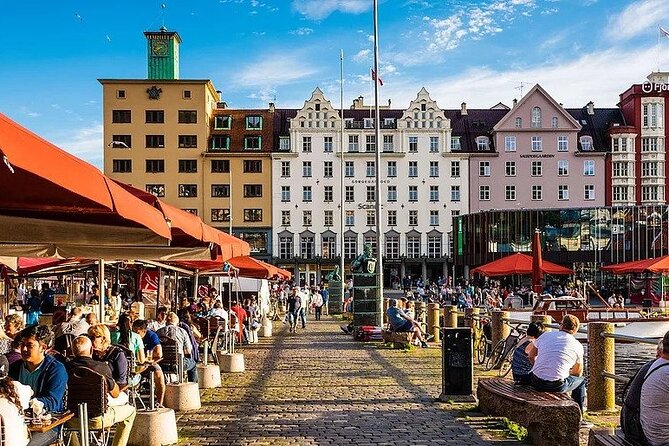
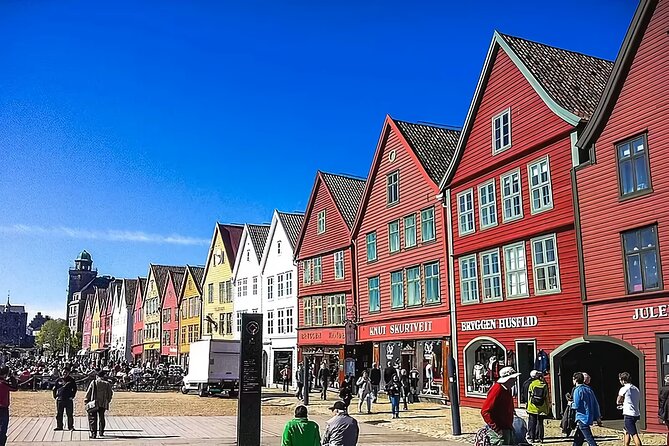
The first major view is Bryggen, Bergen’s UNESCO-listed Hanseatic wharf. The site began as one of the earliest settled parts of Bergen and became a key trading center for the German merchants who operated along the waterfront.
From the water, you see the full run of the old wharf rather than only the narrow lanes between its buildings. The perspective helps you understand how the warehouses faced the harbor, where ships could load and unload directly beside the trading houses.
Look behind Bryggen for St. Mary’s Church, completed around 1180. It is the oldest surviving building in Bergen. The church began as a parish church for the Norwegian population, then came under the control of Bergen’s powerful German community in 1408.
Its basilica design is unusual for a parish church. The tall central nave rises above two lower side aisles, a form more often linked with medieval cathedrals. From the boat, the church is not an interior visit, of course, but its age and stone construction provide a useful contrast to Bryggen’s timber buildings.
If you are using the cruise to plan your walking time, Bryggen and St. Mary’s Church deserve a closer look after the boat ride. The cruise gives you the outline. Your feet provide the detail.
Bergenhus Fortress and the royal center of medieval Norway
Next comes Bergenhus Fortress, one of Norway’s oldest and best-preserved stone fortifications. The site includes buildings from as early as the 13th century, when Bergen served as Norway’s capital and this waterfront area was the main seat of the country’s rulers.
The fortress occupies what was once called Holmen. In medieval times, the area held the royal residence, a cathedral, several churches, the bishop’s residence, and a Dominican monastery. Excavations have found foundations that may date to before 1100.
Håkon’s Hall is the key building here. Constructed in 1247, it was the grandest structure in the medieval royal residence. The cruise does not replace a visit inside the fortress, but it shows how directly the royal center faced the harbor.
This is one of the best historical sections of the route because the fortification is not an isolated monument. It sits within the working harbor, beside the places where ships arrived and political power was concentrated.
Skuteviken, Sandviken, and old wooden waterfront life
As the boat moves beyond the central harbor, the scenery becomes less polished and more residential. Skuteviken developed as an outlying suburb under the protection of Sverresborg Fortress, built in 1183.
Small wooden houses appeared here without much overall planning. The district grew through the 18th century, and its name probably refers to the ship bay where merchants from Bryggen brought vessels for maintenance and careening.
That detail helps explain the practical side of the harbor. Bergen was not only a pretty trading town. It was a place of repairs, cargo, rope, fish, sailors, and hard waterfront work.
The cruise also passes the Sandviken area and the small islet of Måseskjæret. The first settlement on the islet dates from 1804, when it served as a summer residence. One notable house, Måseskjæret 1, was built by Christopher Kahrs in 1795 and later protected by Norway’s National Heritage Board.
Today, modern apartments share the view with older homes. That mixture is part of the appeal, but do not expect every sight to be a preserved historic scene. The route shows Bergen as a living city, with old, restored, modern, and industrial elements together.
Same base, a different kind of day out:
- From Bergen: The Original Fjord Cruise to Mostraumen
★ 4.7 · 8,440 reviews - Bergen: Mostraumen Fjord & Waterfall Cruise
★ 4.6 · 2,990 reviews - Bergen: Past & Present Small Group Guided Walking Tour
★ 4.9 · 1,609 reviews - Walking Tour in Bergen of the Past and Present
★ 5.0 · 1,575 reviews
Byfjorden and the story of war on the water
The route reaches Byfjorden, a 15-kilometer inlet separating Askøy from the Bergen Peninsula. You get a wider view here, with the city receding behind you and the harbor opening into a larger body of water.
This stretch carries an important military story. In 1665, during the Second Anglo-Dutch War, a naval battle took place near Bergen after a Dutch fleet sought refuge in the city’s neutral port while being pursued by English warships.
Local forces joined the Dutch side. The fight was short and bloody, and the English withdrew. A cannonball embedded in Bergen Cathedral has long been linked to this battle, although the story is best treated as part of the city’s long maritime memory.
The views here depend heavily on weather. On a clear day, the open water gives the cruise breathing room after the tight harbor. In rain or low cloud, the ride becomes more about the narration and less about scenery, so keep your expectations realistic.
The Laksevåg submarine bunker and WWII memory
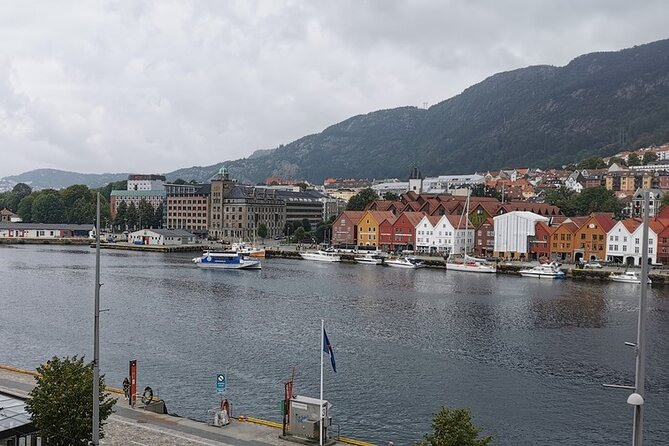
One of the route’s more striking sights is the submarine bunker Bruno at Laksevåg. German occupation forces built it into the mountain beginning in 1941, using enormous quantities of steel, sand, cement, and dynamite.
The bunker’s five-meter-thick concrete roof sheltered three docks. Allied aircraft attacked the facility in October 1944, but most of the bombs missed the target and hit nearby homes instead. The attack killed 193 civilians, including 61 children at Holen school.
That history changes the tone of the cruise. Bergen’s harbor can look calm and picturesque, but it was also a military center during the war. The bunker remains in use by the Norwegian Navy, so you see a working site rather than a museum prepared for visitors.
The narration is especially useful here, provided you can hear it. If you sit outside, check that the speakers carry clearly. Several people have found the audio easier to hear indoors, while others preferred the open deck for photographs.
Shipbuilding, USF Verftet, and the western waterfront
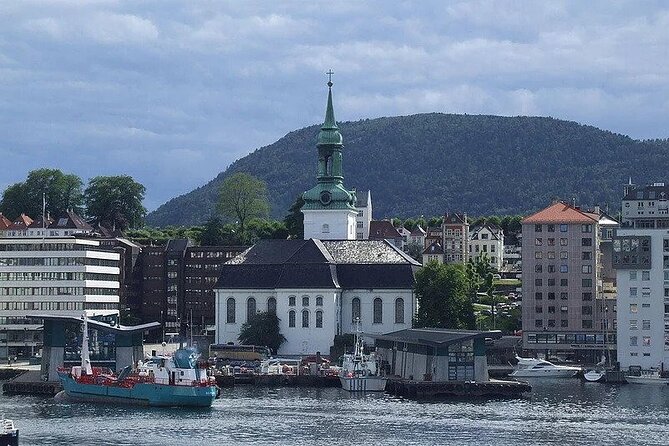
The boat passes the former Georgernes Shipyard, founded in the 1780s. Its most important period came after Annanias Dekke took over in 1853. Dekke had learned shipbuilding in Boston and became known for designing and building fine sailing ships.
Part of the shipyard later became a major sardine factory. Today, the site has a very different role as USF Verftet, a large art and culture center with studios, companies, and creative businesses.
I like this part of the route because it shows how Bergen’s waterfront keeps changing without losing its working identity. Medieval trade gave way to shipbuilding, then food processing, then arts and culture. From the boat, those layers are easier to see than from a single street.
Nordnes, Fredriksberg, and the city’s sea pool
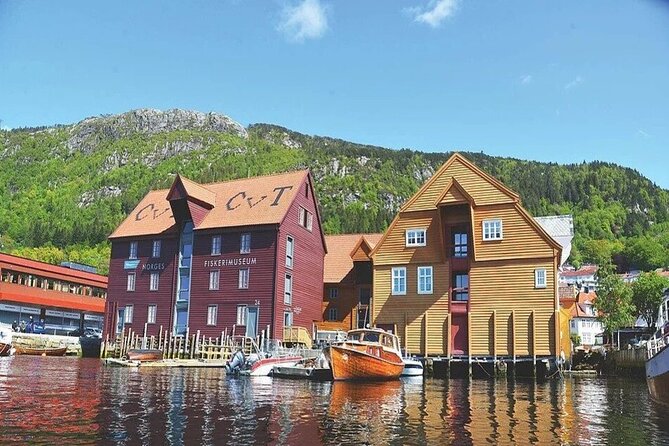
The cruise continues around the Nordnes Peninsula, where Fredriksberg Fortress occupies the high point. The fortification once protected the peninsula with cannon batteries and offered views toward Bergen’s center and Laksevåg.
Fredriksberg also served as a fire lookout. From the 18th century, the military used cannon shots to signal where a fire had broken out in the city. The fire service ended in 1926, but the fire tower still remains on the fort.
Nearby, Nordnes Sea Water Pool adds a more relaxed modern note. The pool opened in 1910, beginning with floating wooden boxes attached to the shore. The present facility includes a 25-meter heated saltwater pool, a sea-water plunge, changing rooms, and a sauna.
You will not stop for a swim on this cruise, but the pool is a useful landmark if you plan to return to Nordnes. The area combines old defenses, local recreation, and harbor views within a short walk of the center.
Bergen Aquarium is also located here. It opened in 1960 and includes fish, aquatic animals, penguins, and a tropical section with snakes, crocodiles, spiders, and lizards. Outdoor ponds hold penguins, sea lions, otters, and large fish.
Customs, churches, and the Fish Market
Back toward the central harbor, the route passes the former customs area. Bergen’s first customs house appeared in 1561, along with a huge wooden structure and jetties reaching more than 100 meters into the water.
Those long jetties allowed large ships to dock in deep water. The customs extension also narrowed the harbor and helped officials control smuggling. This is a small but revealing detail: even the shape of the waterfront was designed around trade and regulation.
Nykirken, or the New Church, is another visible landmark. It was consecrated in 1622 as Holy Trinity Church. The nickname came from the fact that Bergen already had much older churches, although repeated fires and rebuilding have made this site literally new several times.
You also pass Murhvelvingen, a building dating from after the 1561 city fire. It served as a private residence and office for the sheriff of Bergenhus Fortress. Its stonework includes soapstone taken from monastery ruins, and its lower rooms have held shops since the 17th century.
The cruise ends near the Fish Market, one of Bergen’s best-known public meeting places. The square has served townspeople, farmers, merchants, and fishermen for centuries. The outdoor market operates from May through September, while the indoor food hall remains open year-round.
If you want seafood or a snack after the cruise, this is the obvious place to continue. The market is convenient, but prices can vary, so check before ordering.
Price, boat comfort, and the practical details
At $28.97 per person, this is fairly priced for a one-hour city cruise. You are paying for a relaxed overview, harbor access, and onboard information rather than a full guided tour with extensive time at each landmark.
The value is strongest on your first day in Bergen, after a long journey, or when your group includes people who do not want a hill-heavy walking route. It also works well for families with teenagers, who may appreciate the change of pace, and for older visitors who want to see the city without covering every street.
The vessel can hold up to 92 people. That means this is a proper sightseeing boat, not an intimate small sailboat. You can usually choose between an indoor area and an outside deck. Blankets are available in cold weather, but Bergen’s wind and rain still matter.
The activity is described as wheelchair and stroller accessible, and most people can participate. Still, boat access can be more difficult than expected for someone using a wheelchair or walker. Ask the crew for help, and allow extra time when boarding.
The cruise includes the sightseeing ride and narration. Food and drinks are not included. The audio has been praised when clear, but recorded narration can feel flat, and poor speakers or background conversation may make it hard to follow. If the weather allows, sit outside for the view, then move indoors if you need clearer sound.
Free cancellation is available until 24 hours before the start time. Cancellations or changes made within 24 hours are not refunded or accepted. Because a small number of departures have been canceled for mechanical problems, keep your booking confirmation and check for updates before heading to the pier.
Who should book the Bergen City Cruise?
I would book this cruise if you want a fast first look at Bergen, prefer sitting to walking, or have only a short time in port. It is also a smart choice for families and mixed-age groups who want one activity everyone can manage.
I would not make it your only Bergen experience. The one-hour route gives you distance and context, but it cannot provide the close-up details of Bryggen, the interior of St. Mary’s Church, or the rooms of Bergenhus Fortress.
Book it early in your stay, then use what you see to choose your walking stops. Pick a clear day if possible, arrive early at Strandkaien 11, and confirm where the boat is boarding. If you mainly want live guiding, ask about the narration before departure. If you want a calm overview with strong harbor views, this is a sensible and reasonably priced choice.
FAQ
How long is the Bergen City Cruise?
The cruise lasts approximately one hour.
Where does the cruise depart?
It departs from Strandkaien 11, 5014 Bergen, Norway.
Where does the cruise end?
The activity returns to the original meeting point at Strandkaien 11.
What sights can I see from the boat?
The route includes Bryggen, St. Mary’s Church, Bergenhus Fortress, Skuteviken, Måseskjæret, Byfjorden, the Laksevåg submarine bunker, USF Verftet, Fredriksberg Fortress, Nordnes, Bergen Aquarium, Nykirken, Murhvelvingen, and the Fish Market.
Is food included?
No. Food and drinks are not included.
Is the cruise suitable for wheelchair and stroller users?
The cruise is described as wheelchair and stroller accessible, and most people can participate. Some boarding situations may be harder for wheelchair or walker users, so allow extra time and ask the crew for assistance.
Is the cruise narrated?
Yes. The captain or onboard system provides information about the sights. The narration may be recorded, and sound quality can vary between the indoor and outdoor areas.
How many people can join the cruise?
The maximum group size is 92 travelers.
Can I cancel for a refund?
Yes, if you cancel at least 24 hours before the experience start time. Cancellations made less than 24 hours before departure are not refunded.
Just added in Bergen
- Walking tour: Medieval Spirit of Bergen + sweet Arctic gifts★ 5.0 · 17 reviews
- Walking Tour of Central Bergen★ 5.0 · 46 reviews
- Mountain Bike – Voss Storålsen★ 5.0 · 13 reviews
- Segway Night Tour of Bergen★ 5.0 · 46 reviews
- Bergen: Private Full-Day Roundtrip to Hardangerfjord with cruise★ 5.0 · 20 reviews
- 3-Hour Private Norwegian Hiking Experience with Local Guide★ 5.0 · 27 reviews
- Private tour to Sognefjord and Flåm from Bergen, 24 hr refundable★ 4.5 · 27 reviews
- Full Day Private Tour to Flam with Pick Up★ 5.0 · 14 reviews
Cruises & Boat Tours, compared.
City Archipelago Sightseeing Cruise with Guide
Read our review →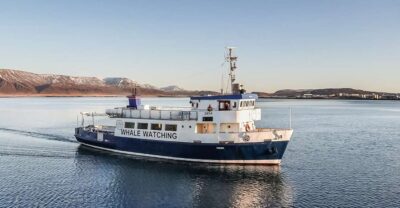
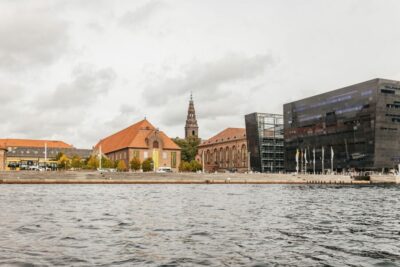
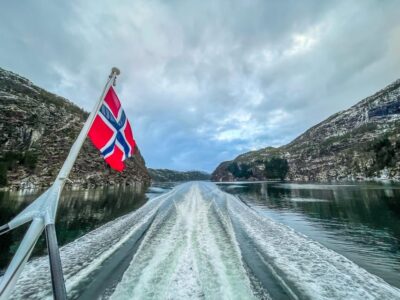
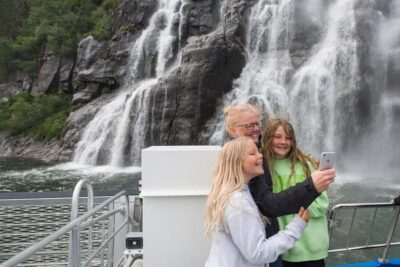
Scenic Fjord Cruise to Lysefjord and Preikestolen
Read our review →
Scenic Fjord Cruise with Audio Guide Commentary
Read our review →
Tromsø’s Top-Rated Fjord & Fishing Cruise – All-Inclusive
Read our review →Browse the lists this tour appears in