
Reviewed · TOURS IN DENMARK
Sights & Gems: Medieval Copenhagen & Nyhavn with a local host
Copenhagen’s best first look may be on foot, and this two-hour walk gives you a tidy route from the grand Marble Church to the colorful canal houses of Nyhavn. Along the way, you’ll see royal gardens, naval homes, old squares, churches, and the palace that now houses Denmark’s Parliament.
I like the small maximum of 12 people, which should make it easier to hear the guide and ask questions. I also like the finish in Nyhavn, where you can stop for coffee or a pastry as soon as the walk ends. The main drawback is that nearly every stop is an outside look, so you should not book this expecting castle or church interiors.
Key points at a glance
- A smart first walk: Cover major Copenhagen sights in about two hours, with little backtracking.
- Small-group format: The group is limited to 12 people, a useful size for city storytelling.
- Royal and naval Copenhagen: See Marble Church, Rosenborg Castle, Christiansborg Palace, and Nyboder.
- Old-town atmosphere: Walk through Krusemyntegade, Gråbrødretorv, Amagertorv, and Kongens Nytorv.
- English-language guiding: Guides such as Maybritt and Maybee have led the walk in clear English.
- Easy ending: Finish at Nyhavn 28, close to cafés, restaurants, and the canal.
A two-hour route through Copenhagen’s royal center
This walk works best as an introduction rather than a full museum tour. You move from Frederiksstaden and the royal quarter through the old center, then finish beside the water at Nyhavn. The route is packed with famous sights, but the short stops mean you are mainly hearing context, taking photos, and getting your bearings.
The price is $28.43 per person. For a guided walk covering this many central sights, that is a fair buy if you value local explanation and have limited time. It is less useful if you prefer to enter museums, linger at each stop, or explore at your own pace. Group discounts are available, and the mobile ticket makes the booking side simple.
The walk is offered in English and usually sells well in advance, with an average booking lead time of 77 days. That does not mean you must plan three months ahead, but it does suggest booking early for a particular date, especially if your schedule is tight.
Other trips people book in Copenhagen:
- Copenhagen: Canal Cruise with Guide
★ 4.6 · 9,115 reviews - Copenhagen: Hop-On Hop-Off Bus Tour with Boat Tour Option
★ 3.9 · 4,122 reviews - Private Walking Grand Tour of Copenhagen
★ 5.0 · 3,953 reviews
Starting beneath the Marble Church
Meet between the stairs leading down to the Marble Church Metro Station, beside a 7-Eleven. This is a practical meeting point because the metro station gives you a clear landmark, and the shop makes it easy to spot the area.
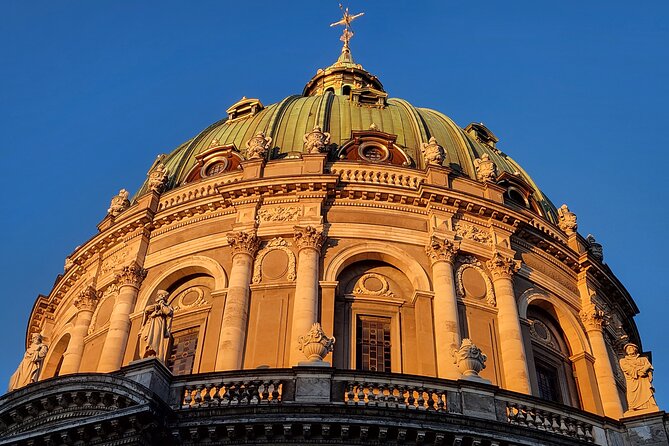
Your first sight is Frederiks Kirke, usually called the Marble Church. Its great dome is the largest in Scandinavia, and the building was inspired by St. Peter’s Basilica in Rome. Construction took more than 150 years, and the church’s Norwegian marble gives it a formal, polished appearance.
The stop is short, about five minutes, and admission is free. You will admire the church from outside, hear about its design and place in Frederiksstaden, and then continue. If the interior matters to you, set aside separate time to return, since this walk does not include an interior visit.
Nyboder and a quieter Copenhagen
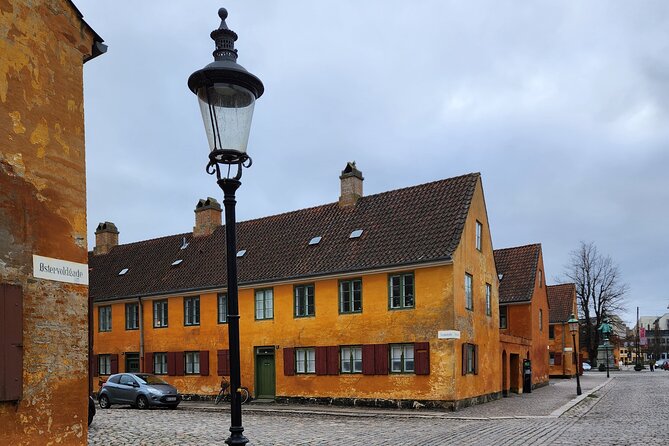
From the grand royal quarter, the route shifts to Nyboder, a naval neighborhood founded in 1631 by King Christian IV. Its original purpose was practical: provide homes for Denmark’s naval families. That gives the area a different feel from the palace district, with a more domestic connection to the city’s seafaring past.
The walk pauses near Nyboder’s Memorial Rooms. You may look through the windows at preserved museum spaces, original objects, uniforms, and maritime items. Admission is not included, and the stop is brief, about five minutes, so think of it as a glimpse rather than a museum visit.
I like this part because it adds ordinary working lives to the royal stories. Kings and palaces can make a city feel distant. Nyboder brings the focus back to sailors and families who helped support Denmark’s naval power.
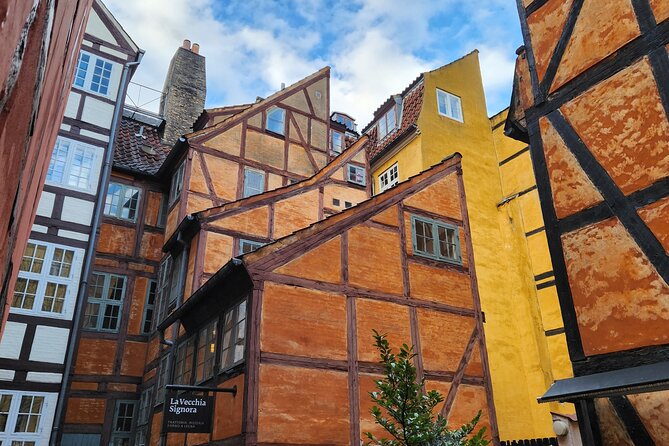
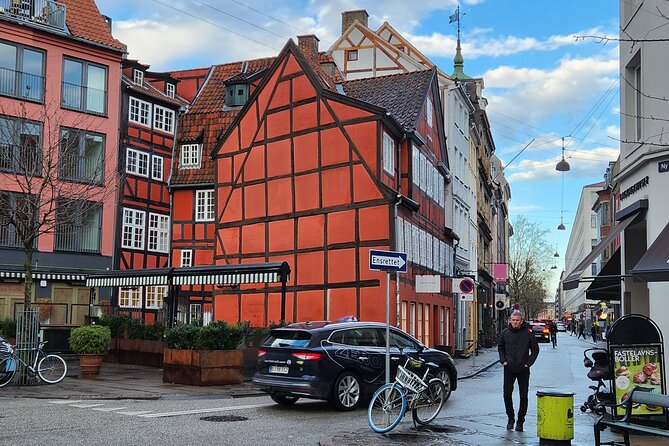
You also pass along Krusemyntegade, a peaceful street lined with colorful old houses. It is a pleasant place for photographs and a reminder that Copenhagen’s character often appears in modest residential lanes, not only at its most famous monuments.
Rosenborg Castle and the King’s Garden
Rosenborg Castle is one of Copenhagen’s most recognizable buildings. King Christian IV built this Renaissance castle in the early 1600s, and it now sits in the King’s Garden, Denmark’s oldest royal park.
The walk pauses outside for around five minutes. You will see the castle’s fairytale profile and stroll through part of the garden, but admission is not included. That distinction matters. The tour gives you a useful orientation and good photo opportunities, while a separate castle visit is needed for the interiors and royal collections.
The garden offers a welcome change of pace. After the compact streets of Nyboder, the open park gives you room to see the castle in context. I would pay close attention to the guide here, since the value is not just the photograph. The story of Christian IV helps connect several later stops on the route.
Same base, a different kind of day out:
- From Copenhagen: Lund and Malmö 2-Country Tour
★ 4.7 · 2,772 reviews - Copenhagen Highlights Walking Tour
★ 5.0 · 2,324 reviews - Copenhagen: Highlights 3 Hour Bike Tour with a Local Guide
★ 4.8 · 2,312 reviews - Hamlet and Sweden Tour – Two Countries in one day !
★ 5.0 · 2,223 reviews
The Round Tower and Copenhagen’s old center
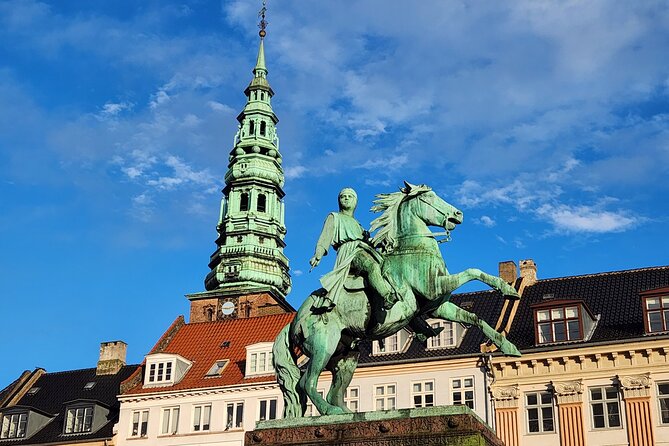
The Round Tower, or Rundetårn, dates to 1642 and was built during the reign of Christian IV. It was created as an observatory and remains one of Copenhagen’s most familiar city symbols.
Again, the tour views it from outside for about five minutes. The copper-clad roof and unusual spiral form make it an easy photo stop, but you will not go up the tower as part of this experience. If you want the city view from above, plan a separate visit.
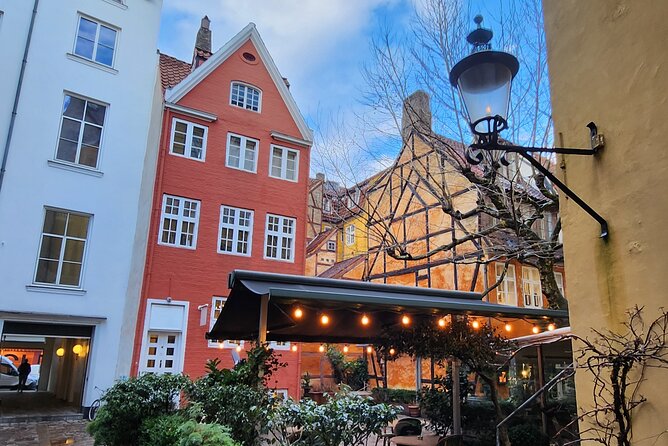
From here, the walk moves into the old center. Gråbrødretorv is one of the prettiest squares on the route, with colorful townhouses, large trees, cafés, and restaurants. It is a good place to slow down and notice the scale of central Copenhagen. The stop is free and lasts about five minutes.
The brief timing is both strength and limitation. You get a well-planned overview, but not much time to sit down, browse, or take many photographs. If a square catches your eye, mark it for a return visit after the tour.
Amagertorv, the Stork Fountain, and city life
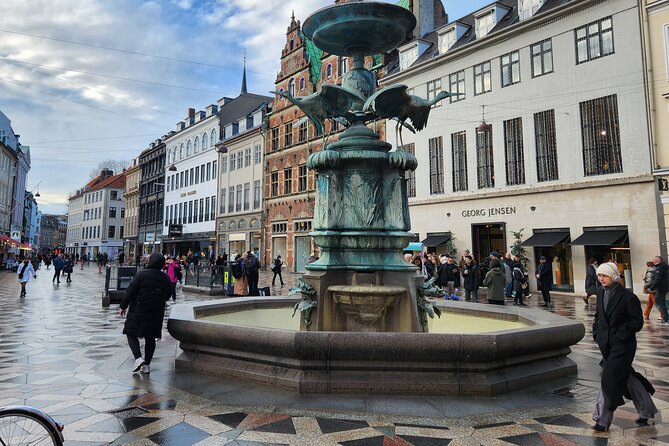
Amagertorv sits in the middle of Strøget, Copenhagen’s main shopping district. The Stork Fountain gives the square an obvious meeting point, while the surrounding buildings and mosaic pavement add plenty to look at.
This is where the tour shifts from old royal Copenhagen to the everyday energy of the city center. You may see shoppers, café customers, and people crossing between major sights. The guide helps connect the square’s appearance to the larger route, so you are not simply passing through a shopping street without context.
The stop is free and takes about five minutes. If you want shopping time, do it after the walk. The tour keeps moving, and its purpose is to explain the city rather than give you a long break on Strøget.
Christiansborg, where monarchy meets government
Christiansborg Palace is one of the most important stops because it links Copenhagen’s royal past with its political present. The palace stands on Slotsholmen and occupies ground used for royal buildings for more than 800 years.
Today the complex houses Denmark’s Parliament, Supreme Court, and Royal Reception Rooms. It is also described as the only building in the world to bring all three branches of government together under one roof. That makes the stop more than a palace photo opportunity.
The guide explains the palace’s fires, kings, queens, and political changes while you view the exterior. The copper spire and grand façade make for strong photographs, but the tour does not include admission to the palace rooms. If you are interested in Danish government or royal ceremony, you may want to return for a longer visit.
I find this section especially useful because it gives the whole walk a clear theme. Copenhagen is not just a collection of pretty buildings. The route shows how royal power, naval service, religion, science, trade, and democracy have all left marks on the same compact city center.
Nikolaj Church and the approach to Kongens Nytorv
Nikolaj Kunsthal occupies a former church with origins in the 1200s. The old church is easy to recognize by its striking spire, and the stop gives you a quick look at another layer of Copenhagen’s religious and architectural past.
Admission is not included, and the stop is outside for about five minutes. That is enough to hear why the building matters and take a photograph, but not enough for an art visit. If you enjoy churches and converted historic buildings, note it as another possible return stop.
The route then reaches Kongens Nytorv, Copenhagen’s grand central square. The Royal Danish Theatre, Hotel d’Angleterre, Nyhavn, and the equestrian statue of King Christian V all help define the space.
This square works as a final orientation point. From here, you can understand how the old center connects to the harbor, the shopping streets, and the royal quarter. The stop is free and takes about five minutes.
Finishing beside the colorful Nyhavn canal
The tour ends at Nyhavn 28, beside Copenhagen’s most photographed canal. The colorful townhouses, old wooden ships, and waterfront cafés make this a natural finish, not just a convenient endpoint.
You will hear about Nyhavn’s earlier life as a working harbor and about Hans Christian Andersen, who lived here. The area once served sailors and traders. Today it is one of the city’s main places for a waterside walk, a meal, or a hot drink.
I like ending here because you can choose what to do next. Stop for a coffee or pastry, eat at one of the restaurants, continue along the canal, or use the area as a starting point for more sightseeing. The route does not force you back to the meeting point.
Keep in mind that Nyhavn is famous for its atmosphere, but the waterfront is also one of the pricier places to eat. The tour itself does not include food or drinks, so use the end point as a choice rather than assuming a café stop is part of the booking.
What the guiding is like
The strongest part of this experience is the explanation between the photo stops. The route covers a lot of ground, and the guide gives you the stories that turn separate buildings into a connected picture of Copenhagen.
Guides have included Maybritt and Maybee. Maybritt was specifically praised for clear, easy-to-understand English and strong city knowledge. Another guide adapted the route during wet and windy weather by finding a warm coffee lounge and continuing the history talk indoors. That is a useful sign of flexibility, though you should still dress for Danish weather.
One past walk also included a guide and photographer, with attention to old buildings, statues, and Danish history. The exact staffing may vary, so do not book on the assumption that a photographer will always be present. The confirmed feature is a live local guide.
The small-group limit of 12 matters here. Copenhagen’s streets can be busy, and a huge group would make short stops harder to manage. With a smaller party, you have a better chance of hearing the explanation and asking about places you want to revisit.
Who should book this walk?
I would recommend it most strongly for a first visit, a short city break, or a cruise stop when you want a clear overview without giving up half a day. It also suits you if you enjoy architecture, royal stories, urban history, and walking between sights rather than riding past them.
It is a good fit for people who want both famous places and less obvious corners. Nyboder and Krusemyntegade help balance the major stops at Rosenborg, Christiansborg, and Nyhavn.
I would choose something else if your main goal is interior access. The Marble Church, Nyboder Memorial Rooms, Rosenborg Castle, the Round Tower, Christiansborg Palace, and Nikolaj Kunsthal are treated mainly as outside stops, and several list admission as not included.
The pace should be manageable for anyone with moderate physical fitness, but you are walking for about two hours and stopping often. Comfortable shoes matter more than dressing up. The tour is near public transportation, and the meeting point by the Marble Church Metro Station is easy to reach.
My booking call
Book this walk if you want a compact, story-led introduction to Copenhagen with a small group and a useful finish at Nyhavn. At $28.43, I think the value is good for the range of sights and the local commentary, especially when your time is limited.
Skip it if you want long museum visits, extensive free time, or a tour built around food. For most first-time visitors, though, this is a practical way to connect Copenhagen’s royal quarter, naval past, old squares, political center, and famous canal in one focused outing.
FAQ
How long is the Copenhagen walking tour?
The tour lasts approximately two hours.
Where does the tour begin?
It begins at the Marble Church, at 1264 Copenhagen, Denmark. The meeting point is between the stairs leading down to the Marble Church Metro Station, next to a 7-Eleven.
Where does the tour finish?
It ends at Nyhavn 28, 1051 Indre By, Denmark.
Is the tour offered in English?
Yes. The tour is offered in English.
How large is the group?
The group has a maximum of 12 participants.
Are entrance tickets included?
The experience includes a live local guide, but admission is not included for stops where an entry ticket is listed. Most sights are viewed from outside during the walk.
What level of fitness is needed?
A moderate level of physical fitness is recommended.
Can I cancel for a full refund?
Yes. You can cancel at least 24 hours before the local start time for a full refund. Changes or cancellations made less than 24 hours before the start time are not accepted for a refund.
Just added in Copenhagen
- a day at North Zealand Castle Tour★ 4.5 · 19 reviews
- Copenhagen Walking Tour: Highlights and Hygge w/Lunch★ 5.0 · 272 reviews
- Exhibition – Home of Carlsberg★ 4.5 · 281 reviews
- The Six Forgotten Giants Trolls Hunt with Minibus★ 4.5 · 27 reviews
- The Hunt For The Six Forgotten Giants★ 5.0 · 45 reviews
- Politically Incorrect Private Hidden Gems Walking Tour★ 5.0 · 270 reviews
- Social Nightlife Crawl Copenhagen★ 5.0 · 164 reviews
- THE TUBE – Copenhagen: an immersive Experience★ 4.0 · 124 reviews
Tours in Denmark, compared.
Highlights 3 Hour Bike Tour with a Local Guide
Read our review →
Hamlet and Sweden Tour – Two Countries in one day !
Read our review →
Copenhagen Sightseeing Classic Canal Tour With Live Guide
Read our review →
Kronborg, Frederiksborg Castle and Roskilde Tour
Read our review →Browse the lists this tour appears in