
Reviewed · TOURS IN NORWAY
Via Ferrata Åndalsnes West Wall
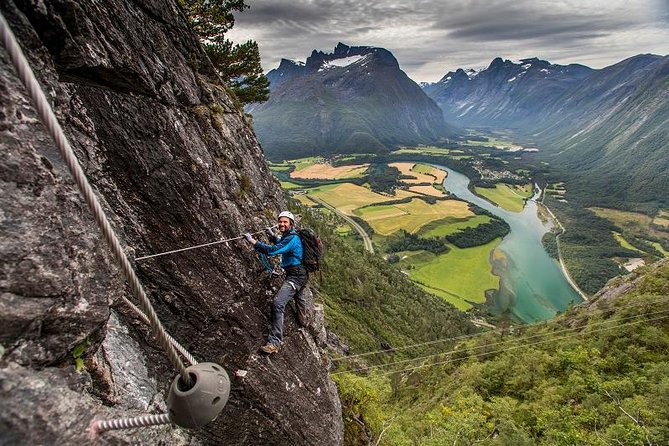
The Via Ferrata Åndalsnes West Wall turns a day in Romsdalen Valley into a real mountain outing. You clip into fixed cables, climb steep metal rungs and rock, and finish high above Åndalsnes before hiking down toward Nesaksla and Rampestreken. I like the mix of hands-on climbing and huge views, plus the fact that technical equipment and a professional guide are included. The main caution is fitness: steep uphill sections, overhangs, and a long descent make this much more than a casual walk.
I also like the small maximum group of 16, since a guide can give more useful help on the harder moves. Guides named in past outings include Mathias, Isaac, and Axel, and their roles go beyond safety briefings: they explain the route, demonstrate tricky sections, and help you keep calm when the wall gets serious. Shorter climbers may find some clips and holds hard to reach, and wet weather can make the metal slippery.
Key points to know before you book
- Three climbing sections: The route includes three main parts, with short overhanging areas and several very steep sections.
- A genuine mountain day: Plan about six hours for the approach, climb, hike down, and return to the Norwegian Mountaineering Center.
- Guide and gear included: Your guide supplies the technical equipment and covers the safety declarations before you start.
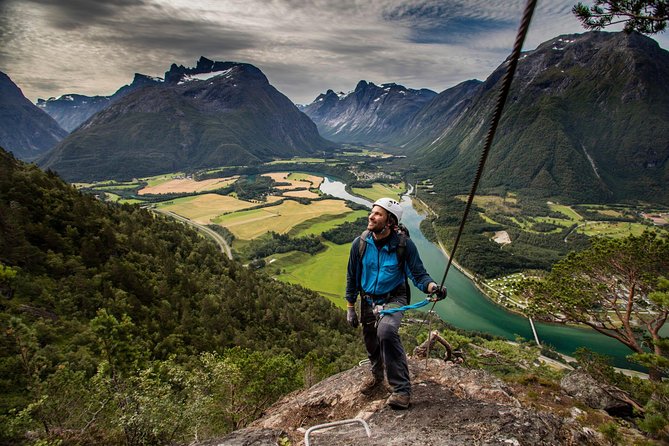
- Excellent Romsdalen views: The wall gives you broad views over Åndalsnes and the valley, although cloud can hide the finish.
- Fitness matters more than climbing grades alone: You need stamina for steep walking between sections, not just strength for the wall.
- Bring your own basics: Food, drinks, rubber gloves, and hiking shoes are not included.
Why the West Wall is worth your time in Åndalsnes
Åndalsnes is a small town with an outsized setting. Mountains rise around the Romsdalen Valley, and the West Wall puts you right into that setting rather than viewing it from a road or lookout.
The appeal is simple: you are not just hiking toward a viewpoint. You are moving vertically, clipping your safety lanyards into the cable, and using metal rungs, rings, foot holds, and sections of natural rock to work upward. The fixed route makes the climb possible for people who are not traditional rock climbers, but it still feels like a proper mountain challenge.
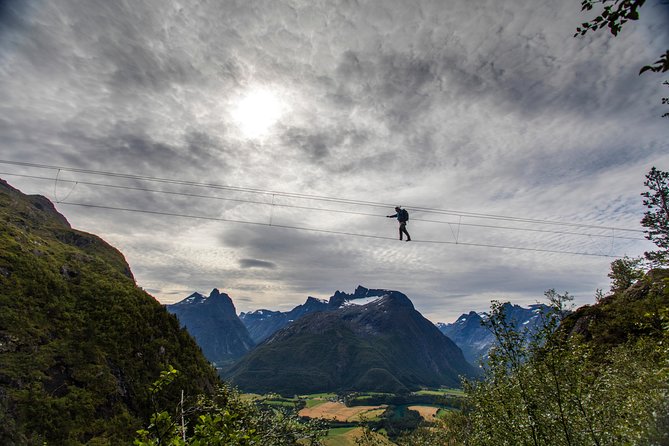
The setting changes as you climb. Lower sections involve steep uphill walking and the first technical moves. Higher sections feel more exposed and demanding, with open views and vertical walls. On a clear day, the payoff is a broad look across the valley and toward the surrounding peaks. In mist, the scenery becomes less reliable, but the climbing remains the main event.
This is a good choice if you want an active half-day that feels distinct from ordinary sightseeing. It is not the best fit if you want a gentle nature walk, dislike heights, or prefer an outing with no fixed physical demands.
Other trips people book in Åndalsnes:
- Geiranger Shore Excursion: Mt. Dalsnibba and Eagle Road
★ 4.5 · 718 reviews - Geiranger: RIB Fjordsafari Geirangefjord
★ 4.5 · 651 reviews - Guided Boat Tour in Geiranger
★ 4.5 · 147 reviews
Meeting at the Norwegian Mountaineering Center
The day begins at the Norsk Tindesenter, or Norwegian Mountaineering Center, at Havnegata 2 in Åndalsnes. The start time is 9:30 am, so you need to arrive ready to begin the safety process rather than treating the meeting point as a casual gathering place.
Your guide goes through the safety declarations and explains the equipment used on the Via Ferrata. This is an important part of the experience. You learn how the system works before reaching the wall, which gives you a better chance to focus on footwork and route finding later.
All technical equipment is supplied. You still need hiking shoes, which are not included, and rubber gloves are also your responsibility. Gloves can be useful because the route uses many metal bars, rings, and holds. One practical tip is to bring water in a system you can reach easily, such as a hydration pack. The harness stays on during the climb, so you should use the restroom before leaving the center.
If you arrive by car, use the long-term parking at Viktoria, opposite the railway station on Isfjordvegen. The activity begins and ends at the mountaineering center, but the actual climb does not start at the door.
The 20-minute walk to the wall
From the center, the group walks about 20 minutes to the starting point. This approach is short on paper, but it is part of the day rather than a transfer you can skip automatically.
There is no parking at the start of the route. One useful detail is that the approach can be longer than the organized 20-minute walk if you arrange your own transport poorly. A separate account of the route describes the starting point as about 1.2 miles from the gondola, with no parking directly at the wall. If you have someone dropping you off, confirm the exact meeting instructions first. Otherwise, follow the guide from the center and treat the walk as your warm-up.
The walk also gives you time to settle into the group. Once the harness is on and the route begins, stopping for basic preparation is less convenient. Bring water, wear your hiking shoes from the start, and keep anything you need accessible.
Climbing the three-part West Wall
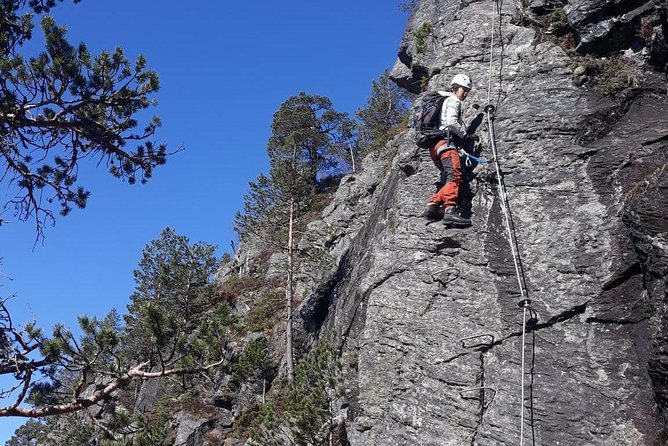
The Via Ferrata has three main sections. Expect a mixture of fixed metal aids and brief stretches where you use the natural rock. The route is not described as one unbroken vertical face, so you should expect steep walking between climbing sections as well as the technical wall itself.
The early uphill portions can be surprisingly tiring. A strong climber who lacks stamina may find the approach between sections harder than the actual handholds. You need enough energy left for the upper parts, where exposure and overhangs add pressure.
The more technical sections include several overhangs. They are short, but they require extra upper-body strength and confident movement. The fixed holds are useful, and the guide can describe the next move or show you how to position yourself. That support matters if this is your first Via Ferrata.
The route can be manageable for people with climbing-park or indoor climbing experience, but it is not a beginner stroll. One experienced pair completed the climb in about two hours and 45 minutes from the end of the pavement to the gondola, without a group ahead of them. In a normal guided group, the full activity is expected to take roughly five to six hours, including the walk and descent.
That difference is worth understanding. A fast private or lightly occupied climb does not represent the pace you should count on. Groups pause for equipment checks, route explanations, encouragement, and tricky passages. Those pauses are useful, especially if your climbing background is limited.
Same base, a different kind of day out:
- Andalsnes Shore Excursion: the Troll Road and Troll Wall
★ 4.5 · 144 reviews - Geiranger: Excursions.no Mount Dalsnibba & Eagle’s Bend
★ 4.5 · 101 reviews - Via Ferrata Åndalsnes Intro Wall
★ 5.0 · 84 reviews - Åndalsnes – Trollstigen & Trollwall Audio Guid Bus Tour
★ 4.3 · 84 reviews
Height, reach, and weather on the route
Your height can affect the difficulty. Shorter climbers may find that the next clip or metal hold is just beyond an easy reach. The route remains possible, but you may need stronger technique, better use of natural rock, and more help from the guide.
This is not a reason to rule yourself out automatically. It is a reason to be honest about your strength and experience when booking. If you are under about 5 feet 4 inches, expect some moves to feel less natural, particularly around the fixed clips and holds. The information available does not set a formal height limit, so ask the provider if you have specific concerns.
Weather changes the feel of the West Wall. Wet rock and muddy sections can make the route more slippery after rain, while wet metal can contribute to blisters. A misty day may cool the wall and still allow a safe climb, but cloud can cover the views near the top.
The route can be completed in wet conditions when the guide judges it safe, but you should not expect the same scenery as on a clear day. If the summit is in cloud, the restaurant and gondola at the top still provide a practical way to finish the mountain portion, but the big valley views may be limited.
The guide makes the hard parts manageable
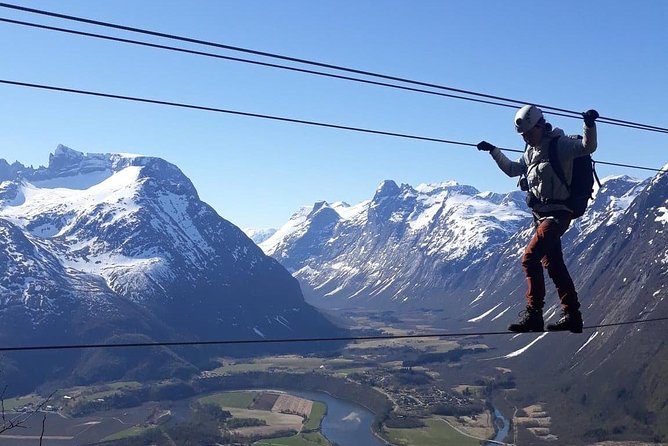
The guide is one of the strongest reasons to choose this outing instead of attempting a Via Ferrata alone. Before the climb, the guide handles the safety briefing and equipment checks. On the wall, the guide helps you understand where to place your feet, how to approach the next cable, and how to deal with the more exposed sections.
Mathias has been described as fun, informative, and reassuring, as well as helpful with photos and videos. Isaac is known for a professional, funny approach and stories about the trolls of the area. Axel has helped first-time Via Ferrata climbers by explaining the route ahead and demonstrating difficult moves.
Those individual guides may not be available on your date, so do not book based on a promise of a particular person. The useful point is that the guide is an active part of the climb, not simply someone leading from far ahead. If you feel stuck, say so early. A quick adjustment in foot placement or body position can make an awkward move much easier.
The maximum group size is 16. That is not a tiny private group, and the route may feel slower if everyone needs help at the same point. Still, a capped group is better than an open-ended crowd, and the guide can manage the order and safety system.
The descent to Nesaksla and Rampestreken
After the wall, the route continues over the mountain toward Nesaksla and Rampestreken before returning to Åndalsnes and the mountaineering center. This is a real hike down, not an immediate walk from the wall to a waiting vehicle.
The descent matters because your legs may already be tired from the steep sections and overhangs. Take food and water, since neither is included. A meal at the top may be available around the gondola area, but you should not rely on that as your only plan.
Some climbers choose to use the gondola down after reaching the top. The gondola is not included in the stated price, and one account puts the ride at 350 NOK. Check the current fare and the day’s operating conditions before you count on it. The guided activity itself ends back at the meeting point, so confirm with your guide if you are considering a different descent arrangement.
Rampestreken adds a familiar Åndalsnes viewpoint to a more demanding day. It can be a satisfying finish because you reach the town by foot after climbing above it, but it also makes the outing longer and more physical than the wall alone.
Is $214.64 a fair price?
The listed price is $214.64 per person. That is not a budget activity, but it covers the professional guide, all technical climbing equipment, and GST. You are paying for instruction, safety management, and access to a structured route in a mountain setting, not simply for a transfer or a walk.
The price makes the most sense if you are new to Via Ferrata or want an organized climb without buying or carrying specialized equipment. It also gives you a clearer plan in changeable mountain weather. For experienced climbers who already own gear and know the route, the cost may feel higher, but the guide still adds value on a route with overhangs, steep transitions, and exposure.
Food, drinks, rubber gloves, hiking shoes, parking, and any gondola ride are extra. Those costs are small compared with the booking price, but they affect the final budget. I would bring your own snacks and water, wear proper hiking shoes, and decide in advance if you are prepared to hike all the way down.
The activity is booked an average of 25 days ahead, so last-minute plans may not work during busy periods. Confirmation is received at booking, and the maximum group size is 16.
Who should book the West Wall?
I would recommend this to you if you have strong general fitness and want a serious, guided mountain activity. Some climbing experience helps, but you do not need to be an expert if you can handle heights, follow instructions, and keep moving for several hours.
It suits people with indoor climbing, climbing-park, or previous Via Ferrata experience particularly well. The technical moves are only part of the challenge. You also need stamina for steep uphill walking, time on your feet, and the descent.
I would pause before booking if you are uncomfortable with exposure, have limited mobility, or want a relaxed scenic excursion. The route may also be frustrating if your reach or upper-body strength is limited, especially on the overhangs. Ask the provider for a current suitability check if you have doubts about fitness, height, or recent injuries.
The activity is offered in English, uses a mobile ticket, and is near public transportation. It requires a minimum number of participants, so if the outing is canceled for that reason, you are offered another date or experience, or a full refund. Otherwise, the booking is non-refundable and cannot be changed, so choose your date carefully.
Should you book this Via Ferrata?
Book it if you want the most active way to see Åndalsnes and you are ready for a full mountain day. The combination of fixed cables, overhangs, guide support, and Romsdalen views gives you something more memorable than a standard hike.
Skip it if you mainly want a viewpoint with little exertion. For everyone else, the price is reasonable for a guided climb with equipment included, provided you budget for food, gloves, shoes, and possibly the gondola. Come prepared, tell the guide about your experience, and treat the West Wall as a climbing route first and a sightseeing stop second.
FAQ
Where does the Via Ferrata Åndalsnes West Wall start?
It starts at the Norwegian Mountaineering Center, Norsk Tindesenter, at Havnegata 2 in Åndalsnes, Norway.
What time does the activity begin?
The stated start time is 9:30 am.
How long does the experience take?
The activity lasts approximately six hours. This includes the safety briefing, a 20-minute walk to the start, the climb, the hike down toward Nesaksla and Rampestreken, and the return to the center.
Is climbing equipment included?
Yes. All technical equipment needed for the Via Ferrata is included, along with a professional guide and GST.
What do I need to bring?
Food and drinks are not included, so bring your own supplies. You also need hiking shoes and should bring rubber gloves if you want them. A hydration system can make it easier to drink while wearing the harness.
Is the activity suitable for everyone?
No. You should have a strong physical fitness level. The route includes steep uphill sections, vertical climbing, and overhangs. The group maximum is 16 people, and the experience is offered in English.
Just added in Åndalsnes
- Geiranger: Sky to Fjord Downhill Biking Adventure★ 4.5 · 23 reviews
- Geiranger: Excursions.no Geiranger Highlights★ 3.5 · 19 reviews
- The Golden Train on Rauma Railway in Romsdalen★ 4.5 · 21 reviews
- Via Ferrata Åndalsnes Intro Wall★ 5.0 · 84 reviews
- Geiranger: Excursions.no Mount Dalsnibba & Eagle’s Bend★ 4.5 · 101 reviews
- Fjord Sightseeing Tour by Boat in Geiranger★ 4.0 · 69 reviews
- City Sightseeing Geiranger Hop-On Hop-Off Bus Tour★ 3.0 · 34 reviews
- Åndalsnes – Trollstigen & Trollwall Audio Guid Bus Tour★ 4.3 · 84 reviews
Tours in Norway, compared.
Reindeer Sledding & Feeding with a Sami Guide
Read our review →
Scenic Fjord Cruise to Lysefjord and Preikestolen
Read our review →
Scenic Fjord Cruise with Audio Guide Commentary
Read our review →

Tromsø’s Top-Rated Fjord & Fishing Cruise – All-Inclusive
Read our review →
Fjords and Sommarøy Islands Tour with Salmon Picnic
Read our review →Browse the lists this tour appears in