
Reviewed · WALKING TOURS
Central Oslo Guided Walking Tour with Local Guide
Oslo’s best introduction may be a walk from the Tiger sculpture to the Royal Palace, because the route joins the city’s waterfront, medieval fortress, civic center, shopping street, and royal quarter in one tidy outing. You get the basic map of central Oslo while a local guide adds the stories that are easy to miss when you walk alone.
I like the two-hour length and the low price of $16.94. I also like the human touch: guides including Suzanne, Alexia, Marta, and Daniel have brought humor, Norwegian history, and useful city advice to the route. The main catch is that the tour covers a fair number of blocks, and the buildings are not visited inside, so you are getting an outdoor orientation rather than a museum tour.
Key points at a glance
- Starts beneath Oslo’s famous Tiger: Meet at Jernbanetorget, beside the sculpture that recalls the city’s Tiger City nickname.
- Links the city’s main districts: The route moves from the station area to the Opera House, fortress, harbor, civic center, main street, and palace.
- A good first-day choice: The walk gives you a clear sense of where central Oslo’s major sights sit in relation to one another.
- History comes with humor: Guides such as Daniel, Suzanne, Alexia, and Marta have been praised for making Scandinavian history conversational rather than lecture-like.
- Buildings are viewed from outside: You do not get included admission to interiors, so plan separate visits to museums or landmark buildings.
- Small price, sizable route: At $16.94, it offers strong value, but you should be comfortable walking across central Oslo for about two hours.
Why this two-hour route works for first-time Oslo visitors
Oslo can feel spread out at first. The train station, waterfront, fortress, City Hall, Parliament, cathedral, and Royal Palace are all central, but they do not form one obvious sightseeing cluster. This walk gives you that connection.
You begin at Jernbanetorget, close to Oslo Central Station, then work toward the waterfront and through the older central streets. From there, the route reaches the harbor districts and turns back toward Karl Johans gate and the Royal Palace. It is a practical westward sweep, not a series of disconnected photo stops.
I would take this tour early in an Oslo stay. You will learn where Aker Brygge is, how to reach the palace, where Karl Johans gate begins, and how the fortress fits into the city’s layout. That makes later exploring easier, especially if you are staying near the station or arriving by train.
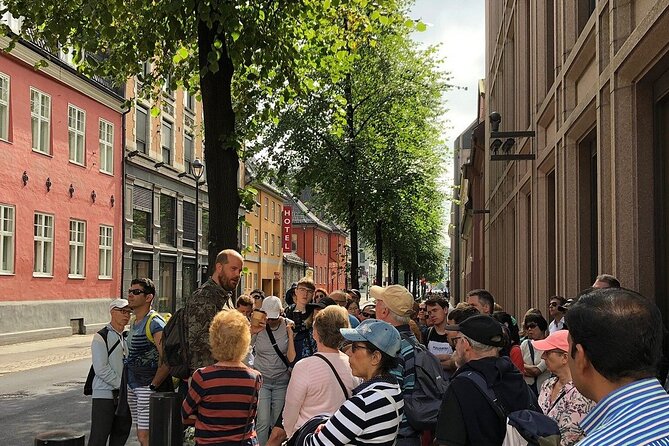
The guides are a large part of the experience. The strongest descriptions of the tour point to friendly delivery, clear explanations, good humor, and an easy pace. Daniel has been singled out for handling a large group well, while Suzanne and Alexia have been praised for mixing useful facts with a relaxed manner. Marta has also led walks that connect Oslo’s past with practical suggestions for the rest of your visit.
This is not a formal history seminar. That is mostly a strength. The best guides explain Norway’s links with Sweden and Denmark, national rivalries, local customs, and city development in short stories that keep the group moving.
A few more things to do in Oslo worth a look
- Oslo: Best of Oslo Walking Tour
★ 4.5 · 458 reviews - Oslo: Guided Walking Tour of Central Oslo
★ 4.7 · 438 reviews - Oslo: Historic Myths & Legends Evening Walking Tour
★ 4.8 · 408 reviews
Meeting Oslo’s Tiger at Jernbanetorget
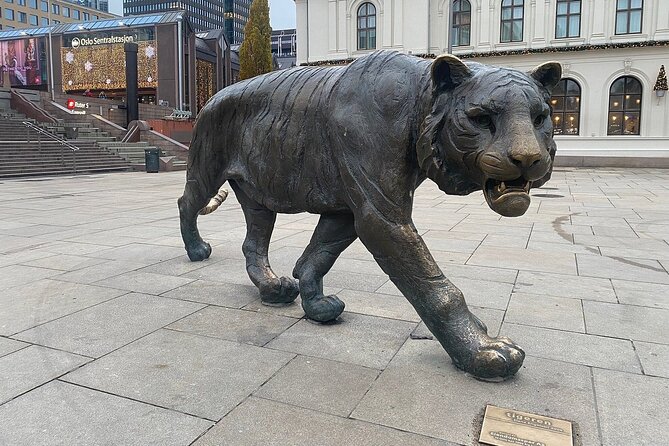
The Tiger sculpture is a smart starting point because it gives the group an unmistakable landmark. It sits at Jernbanetorget, the square by Oslo Central Station, and was installed in 2000 to mark the city’s millennium.
The tiger refers to Oslo’s nickname, Tiger City. The connection comes from a well-known Norwegian poem that compared a city to a tiger and the countryside to a gentle horse. You do not need to know that background before arriving. Your guide will use the sculpture to explain how the nickname became part of Oslo’s public identity.
You get about ten minutes here, with free admission. It is also a useful meeting point if you are arriving by rail or public transport. Look for the guide at the Tiger statue, not simply somewhere around the station square.
This first stop is brief, but it does useful work. You meet the group, get your bearings, and begin with a symbol rather than a long list of dates. If you arrive early, the station area also gives you an easy place to locate the meeting point.
The Opera House and Oslo’s waterfront edge
The Oslo Opera House is one of the route’s most striking modern sights. Completed in 2008, it is home to the Norwegian National Opera and Ballet and is known for its angular design and waterfront position.
The building’s design makes the city feel connected to the fjord. Its sloping exterior is part of what makes it so recognizable, and it is a fine example of Oslo’s newer architectural direction. The tour does not include an interior performance or building visit, so the focus is on the outside structure and the story behind its place in the city.
This is a good point to notice the contrast that runs through the whole walk. Oslo is not only medieval walls and royal buildings. It also has ambitious modern architecture beside the water. The Opera House helps you see that the city’s identity is built from both old and new.
The itinerary does not give a fixed stop time for the Opera House, unlike some other points, so your guide may keep the explanation short depending on the group and pace. That is worth remembering if you want a detailed architectural tour. You are getting an overview, not a specialist design lecture.
Akershus Fortress and the older Oslo
Akershus Fortress provides the route’s strongest link to medieval Oslo. Built around 1299, it was intended to protect the city from invasion. Over the centuries, it served as a military base and prison, and it is now a museum and historic site.
The fortress is important because it explains why Oslo developed where it did. Its defensive position near the harbor helped shape the city’s early political and military life. From the outside, you can appreciate the scale and setting even if you do not spend time inside the museum.
There is one point to clarify before booking. The highlights describe entering Akershus Castle, but the tour information also says that visits inside buildings are not included. You should treat this as an exterior and fortress-area visit unless the operator confirms something different for your departure. If the castle interior is a priority, plan a separate visit and allow extra time.
The walk here may include uneven ground or steps, depending on the exact path used. The overall pace is described as gentle, but this is still a city walk rather than a vehicle tour. Wear shoes that are comfortable for several blocks and possible changes in surface.
Same base, a different kind of day out:
- Oslo: Scenic Fjord Cruise with Audio Guide Commentary
★ 4.5 · 5,375 reviews - Oslo Nature Walks: Island Hopping Tour
★ 4.8 · 2,713 reviews - Oslo: 100% Electric Oslofjord Sightseeing Cruise
★ 4.4 · 2,041 reviews - Oslo: Fjord Evening Cruise with Shrimp Buffet
★ 4.5 · 1,956 reviews
Rådhusgata and Oslo’s older street plan
Rådhusgata gives you a look at central Oslo’s older urban fabric. The street was laid out in the 1620s and leads toward City Hall. Its importance is not based on one dramatic monument. It helps you see how Oslo’s streets developed after earlier periods of change and rebuilding.
The guide spends around ten minutes in this area. That is enough time for a short explanation of the street’s role and for you to connect it with the nearby civic district.
I like stops such as this because they add structure to the walk. A famous building is easy to photograph, but an old street can explain how a city works. Your guide can point out the links between street layout, public buildings, and the harbor, giving the next landmarks more context.
City Hall and the Nobel Peace Prize connection
Oslo City Hall is one of the city’s key civic buildings. Construction ran from 1931 to 1950, and the building represents Norway’s public and cultural life. It is also associated with the annual Nobel Peace Prize ceremony.
The tour allows about fifteen minutes here, one of the longer listed stops. That gives you time to look at the broad exterior, listen to the building’s story, and ask questions.
City Hall is a worthwhile stop even if you are mainly interested in architecture. It helps explain Oslo as Norway’s administrative center, while the Nobel Peace Prize link gives the building international importance. The tour does not include entry, so you will not get the full interior program or art collection as part of this walk.
If you want to return later, note the location carefully. City Hall sits close to the waterfront and is an easy reference point for reaching Aker Brygge and the harbor area.
Oslo Cathedral and Karl Johans gate
The Oslo Cathedral dates from 1697 and is known for its Baroque design. It has been renovated several times, including major work in the twentieth century, and remains both a religious and cultural landmark.
The cathedral is a useful counterpoint to City Hall. One represents modern public life, while the other carries centuries of worship and city tradition. The tour gives you the outside setting and historical explanation, but the building is not included as an interior visit.
From there, the route reaches Karl Johans gate, Oslo’s main street. It runs between Oslo Central Station and the Royal Palace, making it the city’s most useful north-south sightseeing spine. Along the way, you find historic buildings, shops, restaurants, and several major public landmarks.
The listed stop here lasts about ten minutes. That is enough to understand the street’s role, though not enough for serious shopping or dining. I would save purchases for after the tour, since stopping too long can make the group fall behind.
Aker Brygge and Oslo’s harbor life
Aker Brygge is where the route becomes more contemporary and leisure-focused. The district was once a shipyard established in 1854, then changed into a shopping, dining, and entertainment area during redevelopment in the 1980s.
This is a useful place to pause and notice how Oslo has reused its waterfront. The old industrial purpose is largely gone, but the harbor setting remains central to the district’s character. You can return here after the tour for a meal or a walk by the water.
Do not expect a long free period at Aker Brygge. It is one stop within a continuous walking route, not a dedicated food or shopping excursion. Your guide’s explanation is the main point, while your later visit can be more leisurely.
For many people, this is also one of the most pleasant sections for photographs. The route connects the older fortress and civic center with a district shaped by modern redevelopment. That change tells you a lot about present-day Oslo without requiring a separate lecture.
The Norwegian Parliament and the Royal Palace finish
The Storting building, home of the Norwegian Parliament, was built between 1861 and 1866. Its architecture and function make it an important part of the route, especially if you want to understand Norway beyond its scenery.
The Parliament stop links the country’s democratic institutions with the ceremonial world of the Royal Palace. You see how the main street gathers political and royal landmarks within a relatively compact center.
The walk ends in the square in front of the Royal Palace, officially Det Kongelige Slott. This is a sensible finish because you get a clear view of the palace and end near the center of Oslo’s royal quarter rather than back at the station.
The ending also leaves you with options. You can continue around the palace area, return down Karl Johans gate, or use the city center for lunch and further sightseeing. Since the tour finishes at Slottsplassen 1, make sure you do not automatically return to the original meeting point.
Pace, group size, and hearing the guide
The tour lasts about two hours and may include up to 27 people. That is not a private walk, but it is still manageable if the guide keeps the group together.
Group size matters most when you are crossing busy streets, gathering around a landmark, or trying to hear a story in city noise. Some departures use a portable speaker system, which helps. One piece of practical feedback is that a guide may speak quickly, even when using amplification, so stand reasonably close if you want every detail.
The pace is generally described as easy to moderate. It is not a race, but the route covers many central sights. One account calls it a leisurely walk, while another cautions that it covers many blocks. Both can be true: the pace may be relaxed, but the total distance still adds up.
You should be comfortable standing and walking for around two hours. Older walkers can manage it if they are happy with a city route, but anyone with difficulty walking should consider the number of blocks before booking.
The tour requires good weather. If poor weather causes cancellation, you are offered another date or a full refund. Rain does not automatically make the walk impossible, but waterproof clothing and shoes will make a large difference.
Is $16.94 good value?
At $16.94 per person, the tour is priced as an affordable orientation rather than a premium private experience. You are paying for a local guide, a planned route, and the time saved by linking the main sights efficiently.
The value is strongest if you are new to Oslo and want context before exploring alone. A guide can explain why the Tiger matters, how Akershus fits into the city’s past, and where the waterfront districts sit. That basic framework can save you time later.
The price is less compelling if you want interior access, long museum visits, or a very small group. Admission to buildings is not included, and the group can reach 27 people. You will need separate tickets and time for the Opera House, Akershus interiors, City Hall, cathedral, or any other building you want to explore inside.
Free cancellation is available up to 24 hours before the start time. Changes or cancellations within 24 hours are not accepted for a refund, except when the operator cancels because of weather or too few bookings.
Who should book this Oslo walk?
I would recommend it to first-time visitors, couples, families, and anyone arriving by train who wants a quick mental map of central Oslo. It also suits people who enjoy history in short, conversational portions rather than long specialist talks.
Families can benefit from the changing scenery and the Tiger sculpture, fortress, harbor, and palace. Children may not follow every historical detail, but the route has enough visual variety to break up the explanations.
This is a good match for you if you want:
- A short introduction on your first day
- Major central sights in one route
- Local stories about Norway, Sweden, and Denmark
- Advice about what to see next
- A low-cost alternative to a private city tour
You may want another option if you need step-free travel, dislike walking across several city blocks, or mainly want indoor sightseeing. The tour also may not satisfy you if you already know central Oslo well and want detailed treatment of one building.
Should you book the Central Oslo Guided Walking Tour?
Yes, if you want an affordable first look at Oslo and understand that the main reward is orientation and storytelling. The route covers a lot in two hours, and the strongest guides make the history friendly, clear, and occasionally funny.
Book it early in your stay, wear sensible shoes, and stay near the guide when the group gathers around busy streets. Do not book it expecting full entry to the city’s buildings. For $16.94, this is a useful city primer, especially when you want to get your bearings fast before choosing which sights deserve a longer visit.
FAQ
Where does the Oslo walking tour start?
It starts at the Tiger sculpture, Tigeren, at Jernbanetorget, 0154 Oslo, Norway.
Where does the tour finish?
The tour finishes in front of the Royal Palace at Slottsplassen 1, 0010 Oslo, also called Det Kongelige Slott.
How long does the walking tour last?
The tour lasts approximately two hours.
What language is the tour offered in?
The tour is offered in English.
Are building admission fees included?
No. The experience includes a guide, but visits inside buildings are not included.
How many people can join the tour?
The maximum group size is 27 people.
What happens if the tour is canceled because of bad weather?
You will be offered a different date or a full refund if poor weather causes the tour to be canceled.
Just added in Oslo
- The Viking Planet Museum – Mini Group (4 adults)★ 4.0 · 16 reviews
- Unknown war. Oslo and Norway during 1940-45★ 5.0 · 74 reviews
- The Viking Planet Museum Ticket★ 4.0 · 197 reviews
- Oslo Winter Highlights Bike Tour★ 5.0 · 36 reviews
- The Ultimate Study of the Human Form at Vigeland’s Sculpture Park with a Local★ 4.0 · 14 reviews
- The Essential Oslo Private Walking Tour★ 5.0 · 79 reviews
- The Ultimate Norwegian Skiing Experience★ 5.0 · 16 reviews
- Snowshoe Tour in Winter Wonderland – Oslo★ 5.0 · 41 reviews
Walking Tours, compared.

Reykjavik Food Walk – Local Foodie Adventure in Iceland
Read our review →
Reykjavík Small group Walking Tour – by CityWalk
Read our review →


Past & Present Small Group Guided Walking Tour
Read our review →
Walking Tour in Bergen of the Past and Present
Read our review →
Browse the lists this tour appears in