
Reviewed · WALKING TOURS
Oslo City Private Walking Tour
Oslo packs a surprising amount into a short walk. In about two hours, you move from the Nobel Peace Center and City Hall past the Royal Palace, Parliament, and Karl Johans Gate to Akershus Fortress and the harbor, finishing with a view of the Opera House.
I like the private format, since your guide can answer your questions and adjust the route. I also like the range of sights: royal buildings, civic spaces, old military walls, shops, and modern waterfront architecture all appear in one compact introduction.
The main drawback is the price: $239.46 per person is a serious outlay for a two-hour walk. The route also covers busy central streets, and the city traffic can make conversation harder at times.
Key points to know before you book
- A private two-hour orientation: Only your group takes part, so you can ask questions and request small changes.
- A strong first-day route: The walk links Oslo’s main central sights without requiring public transport between stops.
- A final harbor view: You finish near the Oslo Opera House on the waterfront.
- Local personalities included: The route introduces you to figures such as Edvard Munch and Henrik Ibsen.
- Flexible guiding style: Guides including Inger, Diana, Tine, and Anja have been praised for clear stories, good pacing, and useful suggestions for the rest of your stay.
- Outdoor planning matters: The walk runs in all weather, and rain or cold can affect the experience.
A compact route through Oslo’s civic center
This is best understood as an orientation walk rather than a tour built around long indoor visits. Most stops last five to fifteen minutes, giving you a short explanation, a look at the building or square, and time for questions before moving on.
I like this format when I arrive in a new city. You get the basic map in your head quickly, then you can return to the places that catch your interest. The route also gives you a useful sense of how Oslo connects its government district, shopping street, old town grid, fortress, and waterfront.
The guide is the heart of the experience. The named guides associated with this tour include Inger, Diana, Tine, and Anja. Their reported strengths differ slightly in tone, but the pattern is clear: expect local stories, architecture, national history, and practical suggestions for exploring after the walk.
Because the tour is private, you have more control than on a large group outing. You can ask for more detail about art, monarchy, wartime buildings, literature, or modern Oslo. You can also tell the guide if you have already visited one stop and would rather spend more time elsewhere, though major changes depend on timing.
A few more things to do in Oslo worth a look
- Oslo: Best of Oslo Walking Tour
★ 4.5 · 458 reviews - Oslo: Guided Walking Tour of Central Oslo
★ 4.7 · 438 reviews - Oslo: Historic Myths & Legends Evening Walking Tour
★ 4.8 · 408 reviews
Starting at the Nobel Peace Center
The meeting point is the Nobel Peace Center at Brynjulf Bulls plass 1. This is a practical starting place near the harbor and close to several central sights, although one past participant found it slightly out of the way and expected more attention to the building itself at the start.
The center occupies a former train station and focuses on the Nobel Peace Prize, awarded each year on December 10. The tour includes the exterior and a short stop, with admission listed as free. If you want a full museum visit, you should plan separate time, since this walk does not provide an extended indoor visit.
I find the starting point useful because it gives the guide a natural way to introduce Norway’s public identity, international role, and civic traditions. It also begins near the water, where Oslo’s older center meets its newer waterfront development.
Oslo City Hall and the city’s public story
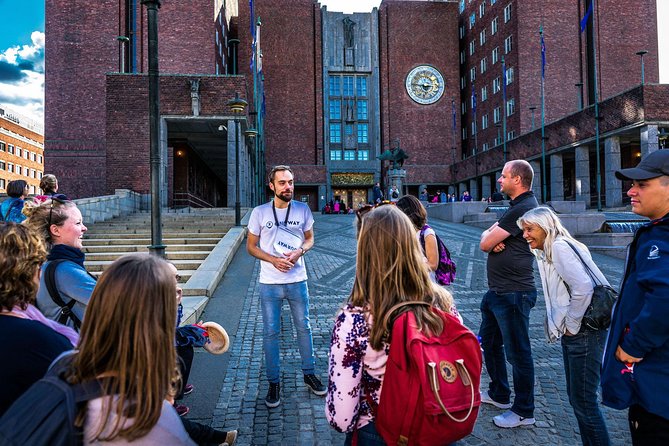
From the Nobel Peace Center, you continue to Oslo City Hall. This is where the Nobel Peace Prize award ceremony takes place, and the building is known for artworks tied to Norwegian history, culture, and working life.
The stop is brief, about ten minutes. That is enough for an explanation and an exterior look, but not a detailed art tour. If murals and public art interest you, listen closely and ask the guide which details deserve a later return visit.
This is one of the more meaningful stops because it connects the city you are seeing with Norway’s national story. You are not just looking at an official building. You are seeing a place used for government, ceremony, art, and international recognition.
National Theatre, the Royal Palace, and Karl Johans Gate
The National Theatre comes next, with roughly five minutes allotted. For more than a century, it has been a main venue for Norwegian classic and modern theater, as well as major celebrations.
I would not expect a full account of Norwegian drama in such a short stop. Instead, think of it as a useful introduction to the cultural figures who shaped Oslo, including Henrik Ibsen. The guide may connect the building and the city to the writers and artists who made Oslo their home.
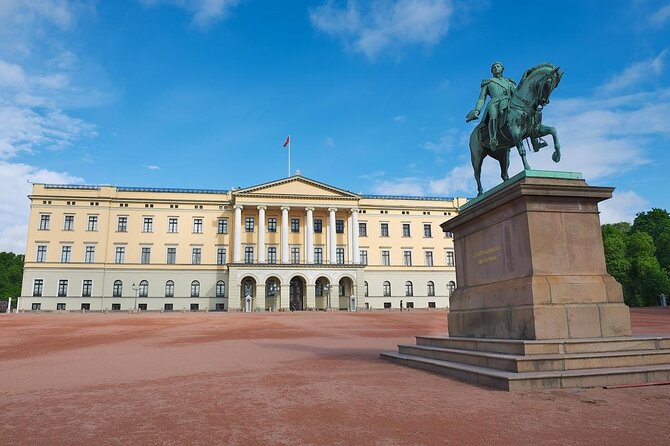
The Royal Palace receives about ten minutes. It is the official residence of the Norwegian monarch, and many members of the Royal Court work there. The palace grounds and broad approach give you a clear sense of the relationship between the monarchy and the city center.
The route then follows Karl Johans Gate, Oslo’s main pedestrian street. At about 1,020 meters long, it links several major buildings and is lined with shops, boutiques, and impressive architecture. This is a good stretch for getting your bearings, though it is also one of the more commercial parts of the walk.
If shopping is part of your Oslo plan, use this section to note places you may want to revisit. If you prefer older streets and local detail, the next stop, Kvadraturen, will likely be more interesting.
Same base, a different kind of day out:
- Oslo: Scenic Fjord Cruise with Audio Guide Commentary
★ 4.5 · 5,375 reviews - Oslo Nature Walks: Island Hopping Tour
★ 4.8 · 2,713 reviews - Oslo: 100% Electric Oslofjord Sightseeing Cruise
★ 4.4 · 2,041 reviews - Oslo: Fjord Evening Cruise with Shrimp Buffet
★ 4.5 · 1,956 reviews
Parliament and Christian IV’s rectangular city
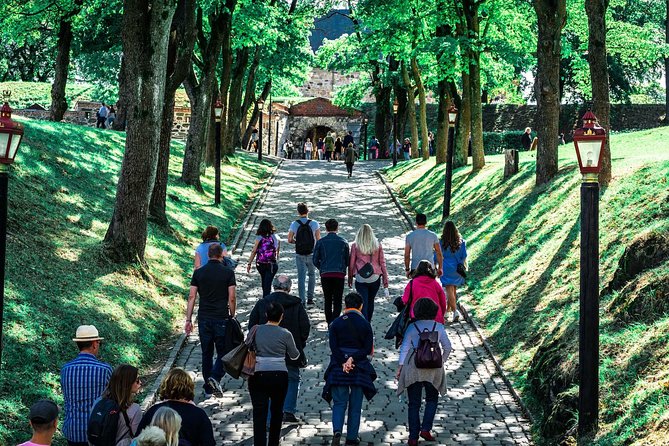
The Norwegian Parliament, known as Stortinget, sits along Karl Johans Gate. The stop lasts about five minutes and gives you a look at the country’s political center.
The building is a reminder that Oslo’s main street is not only for shopping and sightseeing. Government, monarchy, theater, retail, and public ceremony all sit close together. That compact layout is one reason the tour can cover so much in two hours.
You then reach Christian IV’s Glove in Kvadraturen. The name refers to Christian IV’s Renaissance town, laid out in a rectangular street pattern. The area offers a change of mood from the broad central avenue, with older urban planning and a clearer connection to Oslo’s earlier development.
This is the sort of small detail I value on a walking tour. You might pass through the district on your own without understanding why the streets look different. A short explanation turns an ordinary block into part of the city’s story.
Akershus Fortress, the route’s strongest historical stop
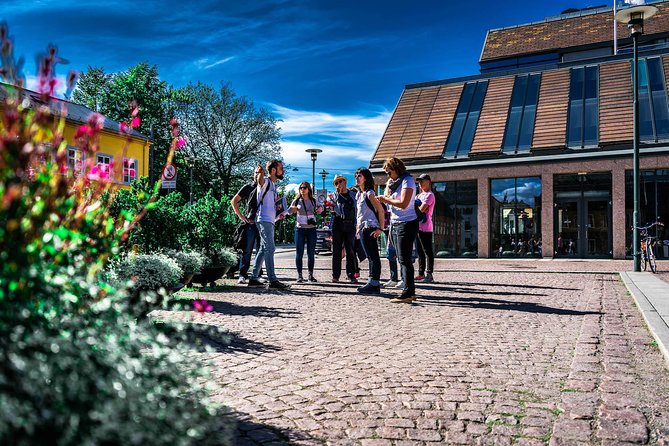
Akershus Castle and Fortress gets the longest scheduled stop, about fifteen minutes. Built along the water, it overlooks the Oslo Fjord and remains one of the city’s defining landmarks.
The fortress is likely to be the visual high point of the central portion of the walk. You get old defensive walls, a commanding position by the water, and a strong contrast with Oslo’s modern buildings. Your guide can help explain why this site mattered to the city’s security and development.
Do not expect a full fortress visit within the tour’s two-hour schedule. The stop is an introduction, not an extended exploration of every courtyard, room, or museum area. If you like military sites or medieval architecture, you may want to return with extra time after the tour.
I especially like having Akershus in the middle of the route. It breaks up the sequence of civic buildings and gives you a more physical sense of Oslo’s age. It also helps explain why the harbor was so important to the city.
Bankplassen, Ibsen, Munch, and the old financial district
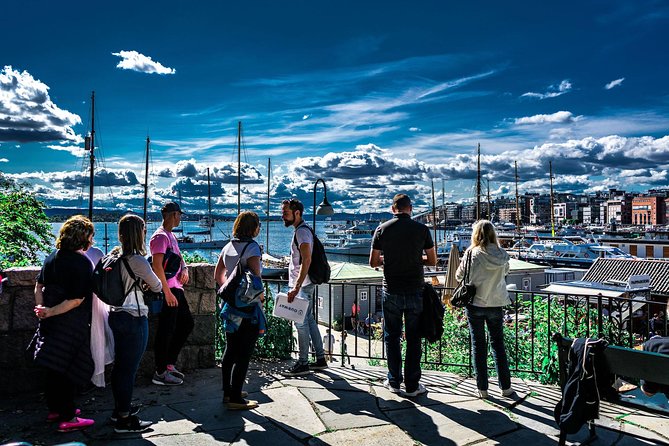
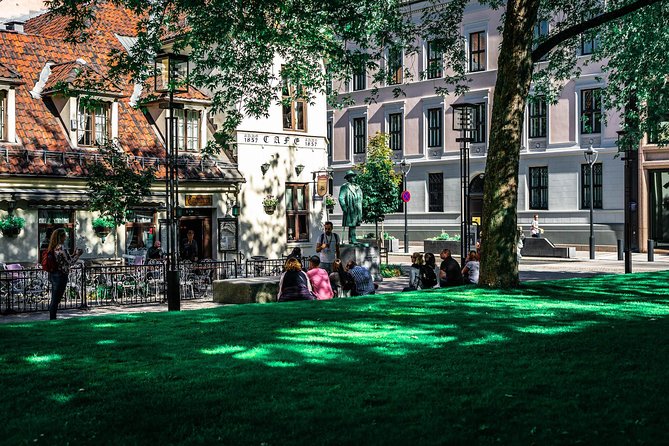
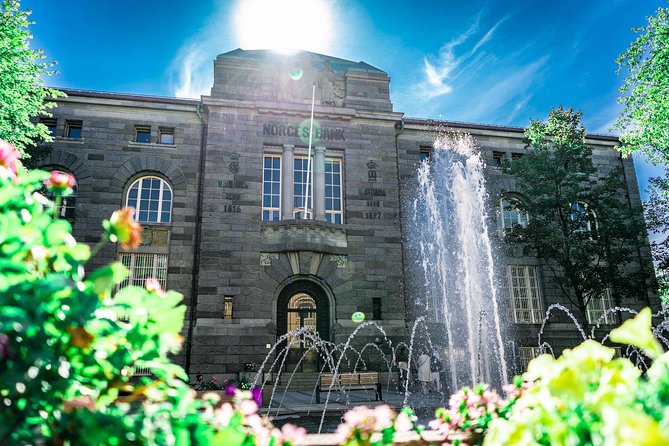
Bankplassen, or Bank Square, marks the area where the Bank of Norway once stood. The square is also linked to Engebret Café, a longtime meeting place associated with well-known Norwegians such as Henrik Ibsen and Edvard Munch.
This is where the tour’s art and literary references can feel more personal. Instead of treating Ibsen and Munch as names in a textbook, the guide can connect them to actual places in Oslo. The walk’s promise to discuss these figures matters most in sections like this, where the city’s creative life becomes tied to streets and cafés.
The stop lasts about ten minutes. That is enough for a story and a look around, but not enough for a meal or a proper café visit. If the connection appeals to you, make a note of Engebret Café for later rather than expecting to sit down during the tour.
The Oslo Stock Exchange follows, with about five minutes. Business leaders worked for years to gain approval and funding for the building, which is now about 180 years old. It adds an economic chapter to a route that has already covered government, royalty, theater, war, art, and literature.
Ending beside the harbor and Opera House
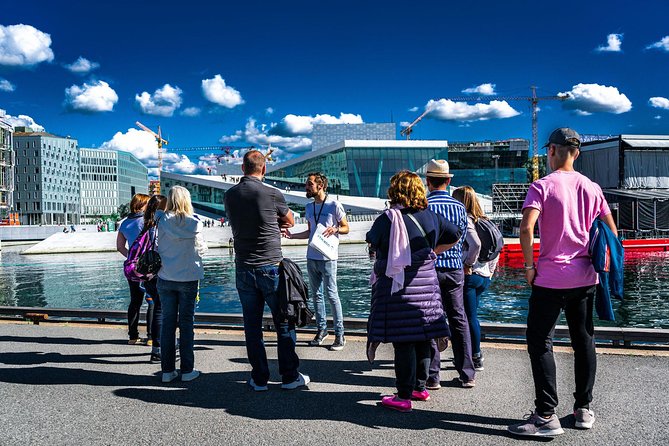
The final section follows Oslo’s harbor promenade toward Langkaia. The tour ends with a view of the Oslo Opera House, one of the capital’s best-known modern landmarks.
This ending works well because it shifts the focus from old Oslo to the city’s newer waterfront. The Opera House also gives you a clear final landmark and a useful point from which to continue exploring on your own. Outdoor performances take place there on selected dates each year, though the walking tour does not include a performance.
The stated end point is Havnepromenade, Langkaia 1. Check your onward plans before booking, especially if you need to return to a ship, hotel, or station at a precise time. The route finishes in a different place from where it begins.
What the private format is worth
At $239.46 per person, this is not a budget sightseeing walk. The value depends heavily on group size. For one or two people, the cost is high. For a larger private group, the per-person price may feel more reasonable because you are paying for a dedicated guide rather than joining strangers.
The main benefit is not exclusive access to monuments. The stops are public, and admission is listed as free. You are paying for the guide’s time, explanations, local perspective, and ability to respond to your interests.
That can be worthwhile on a first day in Oslo. A good guide can help you decide which places deserve a longer visit, explain how the center fits together, and suggest what to do next. A past tour with Inger included indoor breaks during cold, rainy weather and practical ideas for continuing independently. That kind of attention matters more than a long list of facts.
The private setup also helps families and groups with mixed interests. You can ask for a faster pace, more architecture, more political history, or extra time at a particular stop. Still, the tour has a planned sequence, so do not assume every requested change can fit within two hours.
Timing, weather, and walking comfort
The walk operates in all weather. Oslo can be cold and wet, so wear comfortable shoes and suitable layers. One guide adjusted the route to use indoor spaces when the weather turned unpleasant, but you should still plan for a mainly outdoor experience.
Most of the route is in the city center, where surrounding traffic creates background noise. This is worth knowing if someone in your group has difficulty hearing. Stay close to the guide and ask for a repeat when needed.
The tour is listed as suitable for most people, with service animals allowed and public transportation nearby. No special fitness requirement is stated, but it is still a two-hour urban walk with repeated stops and movement between sights.
The tour is offered in English. Confirmation arrives at booking, and free cancellation is available until 24 hours before the scheduled start. Changes or cancellations made inside that window are not accepted for a refund.
Who will get the most from this Oslo walk
I would choose this tour for a first visit, a short stay, or a day when you want a clear introduction before exploring museums and neighborhoods alone. It is especially useful if you want the main central sights explained in a logical order.
It also suits people who prefer conversation over audio guides. Guides such as Diana have covered a lot of ground in two hours, while Tine has balanced architecture, history, personal stories, and humor. Anja has led a quieter history-focused walk, and Inger has been attentive to comfort as well as content.
I would think twice if you want long museum visits, extensive fortress interiors, or a slow photography walk. The route moves at a purposeful pace, and several stops last only five minutes.
I would also compare the cost with a shared group tour if you are traveling alone or as a couple. The private format is most appealing when personal attention and flexible conversation matter more to you than keeping the price low.
Should you book the Oslo City Private Walking Tour?
Book it if you want a fast, personal introduction to central Oslo and value a guide who can connect buildings with Ibsen, Munch, Norwegian politics, royal life, and the city’s waterfront change.
Think carefully about the price and the short duration. You will see many important places, but you will not fully visit them. For a first morning in Oslo, a private group, or a short port stay, the route makes good practical sense. For a deeper cultural visit, use it as an orientation, then return on your own to Akershus Fortress, the Nobel Peace Center, City Hall, or the Opera House.
FAQ
How long does the Oslo City Private Walking Tour last?
The tour lasts approximately two hours.
Where does the tour begin?
It begins at the Nobel Peace Center, Brynjulf Bulls plass 1, 0250 Oslo, Norway.
Where does the tour end?
It ends at the Oslo harbor promenade near Langkaia 1, 0150 Oslo, with a view of the Oslo Opera House.
Is this a private tour?
Yes. Only your group participates, and a professional guide leads the walk.
What language is the tour offered in?
The tour is offered in English.
What happens if the weather is poor?
The tour operates in all weather, so you should dress comfortably and appropriately. Much of the walk takes place outdoors, though the guide may adjust parts of the route when possible.
Just added in Oslo
- The Viking Planet Museum – Mini Group (4 adults)★ 4.0 · 16 reviews
- Unknown war. Oslo and Norway during 1940-45★ 5.0 · 74 reviews
- The Viking Planet Museum Ticket★ 4.0 · 197 reviews
- Oslo Winter Highlights Bike Tour★ 5.0 · 36 reviews
- The Ultimate Study of the Human Form at Vigeland’s Sculpture Park with a Local★ 4.0 · 14 reviews
- The Essential Oslo Private Walking Tour★ 5.0 · 79 reviews
- The Ultimate Norwegian Skiing Experience★ 5.0 · 16 reviews
- Central Oslo Guided Walking Tour with Local Guide★ 4.5 · 278 reviews
Walking Tours, compared.

Reykjavik Food Walk – Local Foodie Adventure in Iceland
Read our review →
Reykjavík Small group Walking Tour – by CityWalk
Read our review →

Past & Present Small Group Guided Walking Tour
Read our review →
Walking Tour in Bergen of the Past and Present
Read our review →
Browse the lists this tour appears in