
Reviewed · MUSEUMS
Copenhagen: Amalienborg Palace Museum Entry Ticket
Amalienborg Palace Museum puts you inside the private world of Denmark’s monarchy. In Christian VIII’s Palace, preserved rooms show how royal family members actually lived, worked, entertained, and displayed their European connections. The grand Gala Hall supplies the ceremony, while Christian X’s dark study and Queen Louise’s salon bring the story down to a human scale.
I like the museum for two clear reasons: the rooms remain furnished as lived-in spaces, and the collection links Danish royalty with Russia and other European courts. The compact visit also works well for families, with child-friendly audio content reported in several museum sections. The main drawback is value: at about $19 per person, you may find the visit short if you move quickly, and there is no guided tour included.
Key points before you go
- See one of Amalienborg’s four palaces: The museum occupies Christian VIII’s Palace, while the Royal Family still resides at Amalienborg.
- Allow 45 to 60 minutes inside: You can spend longer around Amalienborg Square, but the museum itself is fairly compact.
- Look closely at the preserved interiors: Christian X’s study and the royal dining room appear much as they did during their occupants’ lifetimes.
- Do not miss the Fabergé Chamber: Its Russian jewelry connects the Danish and Russian royal families.
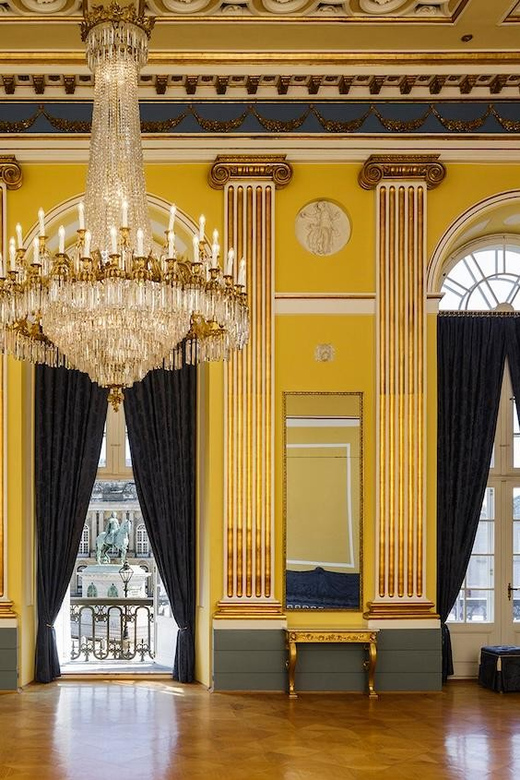
- Expect a grand finish: The Gala Hall rises eight meters and includes gilding, royal views, and sculptures by Bertel Thorvaldsen.
- Arrive on time and travel light: Large bags, backpacks, food, drinks, and baby strollers are not allowed inside.
Entering Amalienborg from the Marble Church

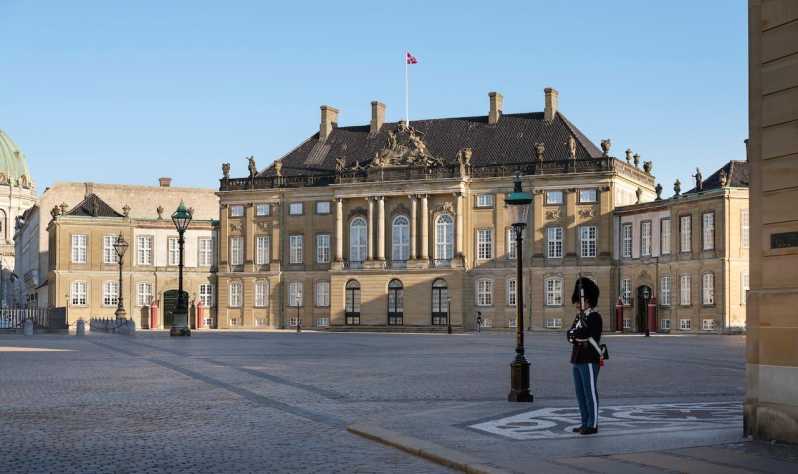
Amalienborg is in central Copenhagen, and the museum entrance is easy to miss if you are focused on the wide palace square. Enter the square from Frederiksgade, near the Marble Church, and use the first building on your left. That is the museum entrance in Christian VIII’s Palace.
Your online ticket is not quite the final step. Before going upstairs, you need to go downstairs to the cashier, where staff scan the ticket. Build this into your arrival time. If you arrive more than 20 minutes late, the ticket is no longer valid, so this is not the place to cut things close.
The palace square itself is part of the experience. Amalienborg consists of four palace buildings arranged around the open space, and this museum occupies only one of them. The ticket gives you access to the museum and its exhibitions, not a tour of every royal building around the square.
A few more things to do in Copenhagen worth a look
- Copenhagen: National Museum of Denmark Entry Ticket
★ 4.5 · 960 reviews - Exhibition – Home of Carlsberg
★ 4.5 · 281 reviews - Copenhagen: Danish War Museum Entry Ticket
★ 4.7 · 106 reviews
What the one-day ticket really includes
The admission costs about $19 per person and remains valid for one day. You get entry to the Amalienborg Palace Museum and access to all exhibitions open during your visit. A guided tour is not included.
That price makes the museum a reasonable choice if you enjoy historic interiors, royal collections, or family stories told through objects. It is less convincing if you expect a large palace with hours of rooms to explore. Many people will finish the main route in 45 minutes to one hour, especially if they read only selected labels.
I would pair the museum with time in Amalienborg Square rather than treating it as a full-day attraction. The surrounding palace complex adds atmosphere, but the indoor museum is the part covered by your ticket. If you already plan to visit several Copenhagen museums, compare the admission cost and time with your other choices.
The flexible cancellation policy helps if your day is uncertain. You can cancel up to 24 hours before the visit for a full refund, and the reserve-now, pay-later option lets you hold a place without paying immediately. The practical catch is the strict late-arrival rule, so flexibility does not mean you can arrive whenever you like.
A royal family told through rooms, not just portraits
The strongest feature here is the way the museum uses complete rooms to tell its story. Instead of seeing isolated objects behind glass, you enter spaces preserved with furniture, photographs, paintings, and personal belongings. This gives you a better sense of the people behind the formal portraits.
The museum covers roughly the last 150 years of Danish royal history. That period is long enough to show changing tastes, family relationships, and ideas about royal life, but the route remains manageable. You can move from public ceremony to private routines without needing a full day or a guide.
The displays also help explain why royal residences matter beyond their decorative value. A dining room can show household habits. A study can suggest personality and profession. A private salon can reveal family networks that stretch across Europe. You are reading history through the rooms people chose to inhabit.
An audio guide is available, and child-friendly audio content is provided in sections of the museum. That matters if you are visiting with children. A seven-year-old may not care about succession politics, but a short audio story attached to a room or object gives the visit a clearer hook.
Christian X’s dining room and study
The dining room used by Christian X and Queen Alexandrine is one of the most direct stops on the route. It appears almost as it did during their residence in the palace, from 1899 until Christian X died in 1947 and Queen Alexandrine died in 1952.
Look at the room as a working domestic space, not simply a decorated royal interior. The table setting and arrangement help you picture a family using the palace over decades. The value here is not spectacle. It is continuity. You are seeing a room tied to specific people and a long period of their lives.
Christian X’s study offers a different mood. The room was preserved as though the king had just left, with dark walls and heavy furnishings typical of a gentleman’s study around 1900. The decoration also reflects his background as an officer.
This is one of the museum’s most personal rooms. You can see how a king’s public role coexisted with a private workroom that feels formal, serious, and almost severe. If you rush through the palace looking only for gold and glitter, this is the room you risk missing.
Same base, a different kind of day out:
- Copenhagen: Canal Cruise with Guide
★ 4.6 · 9,115 reviews - Copenhagen: Hop-On Hop-Off Bus Tour with Boat Tour Option
★ 3.9 · 4,122 reviews - Private Walking Grand Tour of Copenhagen
★ 5.0 · 3,953 reviews - From Copenhagen: Lund and Malmö 2-Country Tour
★ 4.7 · 2,772 reviews
Queen Louise’s private salon and European family ties
Queen Louise’s private salon dates from around 1895 and reflects the more modern interior decoration of that period. It feels different from Christian X’s study, which is exactly the point. The museum lets you compare rooms associated with different people rather than presenting royal taste as one fixed style.
Paintings and framed photographs on the tables point to Queen Louise’s family life and her close connections across Europe. You do not need a long lecture to understand the importance of these objects. Family photographs turn royal diplomacy into something more recognizable: relatives, marriages, and connections maintained across borders.
I find this kind of display more useful than a long list of dates. The room gives you a visual sense of how royal families operated as a network. It also makes the people more approachable. You are not looking only at a crown or official portrait. You are looking at the objects placed around a private room.
The salon is also a good stop for anyone interested in interiors. Its value comes from the contrast with the darker study and the more formal ceremonial spaces later in the visit.
The Fabergé Chamber and its Russian connection
The Fabergé Chamber adds a focused art collection to the royal rooms. It contains hand-crafted Russian jewelry made between 1860 and 1917, with special attention to the ties between the Danish and Russian monarchies.
The collection includes the Fabergé coronation brooch created for the coronation of Tsar Nicholas II. That single object gives the room a strong historical anchor. It connects craftsmanship, ceremony, and the political relationships of Europe’s royal families.
You should give yourself time here even though the chamber may not be large. Fine jewelry rewards close looking. Notice the workmanship, materials, and ceremonial purpose rather than simply walking past the display as another royal cabinet.
This room also broadens the museum beyond Denmark. The palace is Danish, but the family story reaches into Russia and across Europe. That makes the museum useful for visitors who want more than local architecture or a quick look at royal furniture.
The Gala Hall, where the palace becomes theatrical
The Gala Hall is the museum’s grandest interior. Its ceiling rises eight meters, and the room combines heavy gilding with a view toward the palace square. It is the kind of space that makes the public side of monarchy immediately clear.
The Royal Family commissioned artist Nicolai Abildgaard to design the interior in 1794. Sculptures by Bertel Thorvaldsen add another layer of Danish artistic importance. You are not only seeing a lavish reception room. You are seeing a carefully planned statement about royal power, national art, and ceremony.
The Gala Hall also gives the visit a useful change of scale. Earlier rooms feel personal and domestic. Here, the setting is designed for display and formal occasions. If you are short on time, make this room one of your priorities, along with Christian X’s study and the Fabergé Chamber.
Take a moment to look back toward the square. The relationship between the room and the open palace space helps you understand how Amalienborg was designed for both private residence and public ceremony.
The former Frederik X exhibition
A special exhibition titled Frederik X: King of Tomorrow ran from March 22 through September 8, 2024. It marked the succession of the Danish throne on January 14, 2024, and presented a portrait of the new king through photographs, objects, video clips, paintings, and sound.
If you are using older information to plan a visit, do not assume this exhibition is still open. Its listed run ended on September 8, 2024. The museum ticket includes current exhibitions, but the special displays can change, so check what is showing for your date.
The exhibition format is worth noting because it differs from the preserved rooms. Instead of reconstructing an earlier royal interior, it uses several media to present a modern monarch. That contrast can help you see how royal public image has changed from formal palace rooms to photography, video, and sound.
How long should you plan for?
Give the indoor museum 45 minutes to one hour if you want a comfortable visit. You can move faster if you are focused on highlights, or spend longer with the jewelry, photographs, and room details.
Plan extra time outside for Amalienborg Square. The museum ticket is for the palace museum, but the square helps you appreciate the four-building complex and its central setting in Copenhagen. The museum is also within a roughly 15-minute walk of the city center, according to the supplied visitor information.
The route is well organized, so you do not need to guess where to go next. That is helpful in a compact museum, especially when you are visiting with children or fitting the palace between other Copenhagen sights.
There is no guided tour included. If you prefer a guide to explain every room and connect the royal family stories for you, this ticket may feel limited. If you like moving at your own pace and choosing which objects deserve your attention, the audio guide and clear route should be enough.
Practical rules that affect your visit
Travel light. Large luggage, large purses, backpacks, bags, food, drinks, baby strollers, and pets are not allowed inside. Assistance dogs are allowed. These rules matter because you do not want to arrive with a day bag that cannot enter, especially if you are moving between hotels or train stations.
The museum is wheelchair accessible. You still need to follow the entrance procedure, including scanning your online ticket at the downstairs cashier before going upstairs.
Arrive early enough to find the correct palace building and complete the ticket scan. The entrance is in the first building on the left when you enter from Frederiksgade or the Marble Church. The 20-minute late limit is strict, so allow time for finding the square and the entrance.
Because the ticket is valid for one day, you have some planning room once you arrive on time. The information provided does not specify fixed tour start times, so check availability for the date you want.
Who will enjoy Amalienborg Palace Museum most?
I would choose this museum if you like royal history told through real rooms and personal objects. It is especially suitable for visitors who want a focused cultural stop rather than a large, exhausting palace complex.
Families can do well here because the visit is short and child-friendly audio content is available in the museum sections. The rooms also offer visual variety: dark wood, photographs, jewelry, gilding, sculpture, and a large ceremonial hall. That gives children more to notice than a long series of identical portrait galleries.
Architecture and design enthusiasts will appreciate the contrast between the private rooms and Gala Hall. People interested in European dynasties should make time for the Fabergé Chamber and Queen Louise’s salon.
I would be more cautious if you are measuring every admission against the number of objects or rooms. One visitor found the price high for the amount on display, and that is a fair concern. At $19, the museum works best when you value preserved interiors and context, not simply quantity.
Should you book the Amalienborg Palace Museum ticket?
Book it if you want to see how Danish royalty lived, not just where they held ceremonies. The preserved dining room, Christian X’s study, Queen Louise’s salon, Fabergé jewelry, and eight-meter Gala Hall give you a compact but varied picture of the monarchy.
Skip it if you want a long palace visit with many open rooms or a live guided explanation. You may finish in under an hour, and a guide is not included.
For most visitors, I would treat it as a well-planned stop between the Marble Church, Amalienborg Square, and central Copenhagen. Arrive on time, leave bulky bags behind, and focus on the rooms that reveal personality. That approach gives the $19 ticket its best value.
FAQ
Where is the Amalienborg Palace Museum entrance?
The entrance is in the first building on your left when you enter Amalienborg Square from Frederiksgade or the Marble Church.
What does the ticket include?
The ticket includes entry to the Amalienborg Palace Museum and access to all exhibitions open during your visit.
Is a guided tour included?
No. A guided tour is not included. An audio guide is available, including child-friendly audio content in sections of the museum.
How long is the museum visit?
Most people should plan on about 45 minutes to one hour inside the museum. You can spend additional time exploring Amalienborg Square outside.
What happens if I arrive late?
If you arrive more than 20 minutes late, your ticket is no longer valid. Allow time to find the correct palace building and scan your online ticket at the downstairs cashier.
Are bags and strollers allowed inside?
Large bags, large purses, backpacks, luggage, and baby strollers are not allowed. Food and drinks are also prohibited. Assistance dogs are allowed, but other pets are not.
Is the museum wheelchair accessible?
Yes, the activity information states that the Amalienborg Palace Museum is wheelchair accessible.
Just added in Copenhagen
- a day at North Zealand Castle Tour★ 4.5 · 19 reviews
- Copenhagen Walking Tour: Highlights and Hygge w/Lunch★ 5.0 · 272 reviews
- Exhibition – Home of Carlsberg★ 4.5 · 281 reviews
- The Six Forgotten Giants Trolls Hunt with Minibus★ 4.5 · 27 reviews
- The Hunt For The Six Forgotten Giants★ 5.0 · 45 reviews
- Politically Incorrect Private Hidden Gems Walking Tour★ 5.0 · 270 reviews
- THE TUBE – Copenhagen: an immersive Experience★ 4.0 · 124 reviews
- Malmö Full Day Private Trip, Sightseeing Tour & Lunch Option★ 5.0 · 93 reviews
Museums, compared.


Perlan Museum Wonders of Iceland Entrance Ticket
Read our review →
Stockholm Pass: Save up to 50% – Includes Vasa Museum Ticket
Read our review →



Hop-On Hop-Off Bus and Perlan Museum Entry Ticket
Read our review →Browse the lists this tour appears in