
Reviewed · HOP-ON HOP-OFF BUS TOURS
City Sightseeing Oslo Hop-On Hop-Off Bus Tour
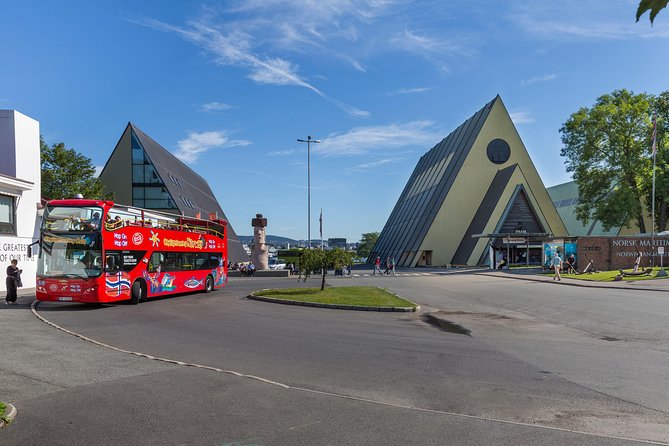
Oslo’s hop-on hop-off bus is most useful as a museum-and-harbor shuttle. In one loop, you can connect the city center with Bygdøy’s major museums, Frogner Park, the cruise terminals, and the Opera House without piecing together several local connections. I especially like the 90-minute overview and the stop near the Viking Ship Museum area, Kon-Tiki Museum, Fram Museum, and Norwegian Maritime Museum.
I also like that you can board at the National Theatre, the cruise port, or several major sights, then use the pass for 24 or 48 hours. The main caution is uneven service quality: buses can fill after cruise ships arrive, audio may be hard to hear or poorly synchronized, and the listed 30-minute frequency is not always dependable.
Key points to know before boarding
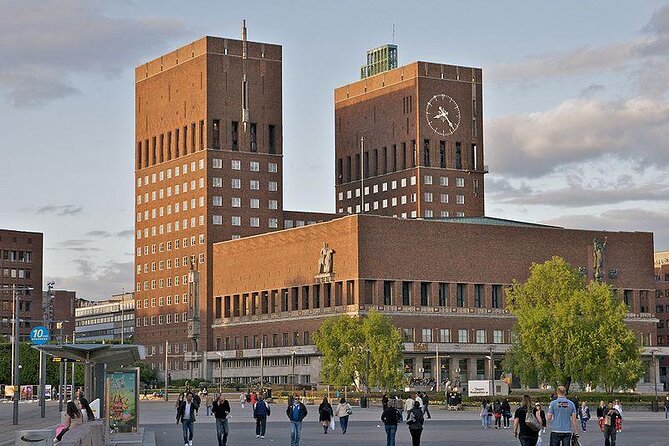
- A 90-minute loop covers Oslo’s main sightseeing corridor, from Karl Johans Gate and the Royal Palace to Bygdøy, the harbor, and the Opera House.
- Bygdøy is the strongest part of the route, with the Norwegian Museum of Cultural History, Kon-Tiki Museum, Fram Museum, and Norwegian Maritime Museum close to the bus stops.
- Cruise passengers get convenient access, with stops at Oslo Cruise Ship Terminal and nearby cruise terminals.
- The tour is seasonal, typically running from June through October, with dates varying each year.
- Audio is offered in eight languages, but bring your own headphones if you plan to use the BYOD option.
- The first bus leaves at 10 a.m. and the last leaves at 4 p.m., so this is not a late-evening sightseeing service.
The best use of the Oslo bus loop
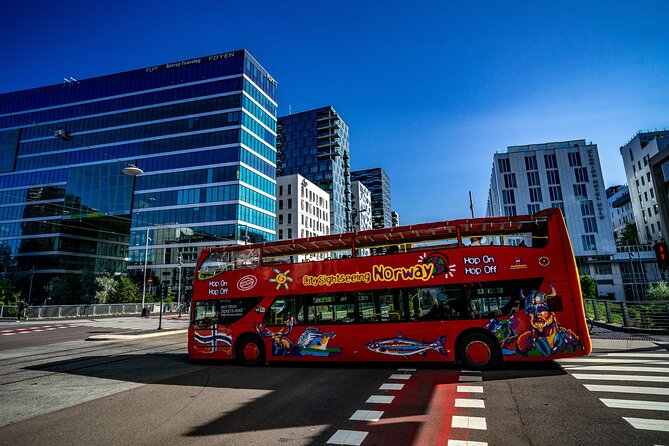
I would use this tour first as a way to get your bearings, not as a substitute for walking around central Oslo. The route links several areas that are spread out, especially the city center, Frogner Park, Bygdøy, and the harbor. That matters because Oslo’s most worthwhile sights are not all gathered around Karl Johans Gate.
The full circuit takes about 90 minutes. You can stay aboard for the entire loop, listen to the recorded commentary, and note the places you want to revisit. This is a good plan on a short visit, in rainy weather, or when you arrive by cruise ship and want a quick look before choosing a museum.
The pass is sold for 24 or 48 hours. That gives you enough time to split the route into sections instead of rushing through every stop in one afternoon. Still, check the operating hours carefully. The first departure from Stop 1 is at 10 a.m., and the last is at 4 p.m. A late sunset does not mean the buses run late.
Buses are advertised every 30 minutes, but allow extra time. Several rides have been affected by delays, skipped stops, full buses, or long waits. If you have a ship to catch, do not make the final bus your only plan back to the port.
More easy ways to cover Oslo:
- Oslo: 24 or 48-Hour Hop-On Hop-Off Sightseeing Bus Ticket
★ 4.1 · 1,470 reviews - Oslo: City Sightseeing Hop-On Hop-Off Bus Tour
★ 3.6 · 724 reviews - Oslo: Grand City Sightseeing Tour by Bus with Fjord Cruise
★ 4.6 · 647 reviews
Stop 1: Karl Johans Gate, the Royal Palace, and the National Theatre
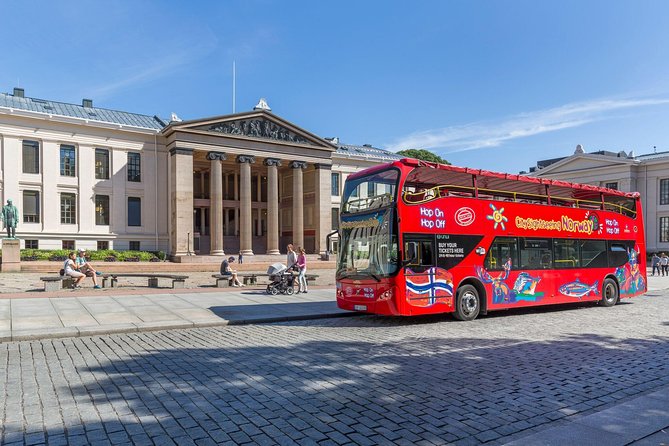
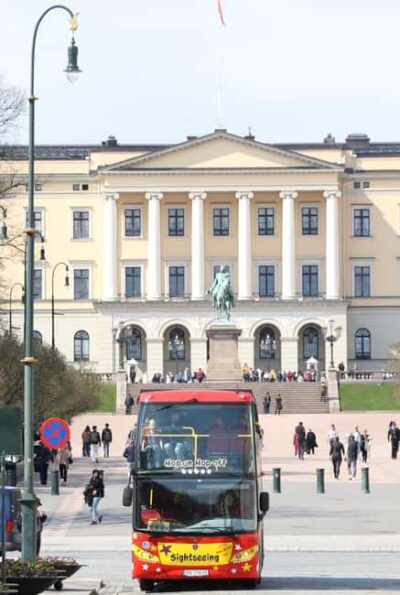
The main stop is at the National Theatre on Karl Johans Gate, Oslo’s central ceremonial street. It is also close to the Royal Palace, so this is the easiest starting point for a first ride through the city.
The Royal Palace is one of Oslo’s essential sights, though the bus only takes you past it. Entrance fees are not included, and visiting the interior requires separate planning. Karl Johans Gate gives you a useful first look at the city center, with the National Theatre and central shopping nearby.
This stop is a practical choice if you are staying in central Oslo. It is also the final stop on the loop, so you can return here after visiting the harbor or Bygdøy.
Stops 2 and 3: Vigeland Sculpture Park and the Norwegian Folk Museum
Stop 2 serves Frogner Park and Vigeland Sculpture Park. This is one of the most memorable stops on the route because the park gives you open space, long walking paths, and Gustav Vigeland’s large collection of human figures in stone and bronze.
You should allow more time here than a quick photo stop. The sculpture park is spread along a long axis, and the experience depends on walking through it rather than viewing it from the bus. If your pass lasts 24 or 48 hours, get off here and give the park a proper visit.
Stop 3 is the Norwegian Museum of Cultural History, also called the Norwegian Folk Museum. It presents Norwegian buildings and cultural traditions in an outdoor museum setting. The route lists Stop 5 at the same museum, so check the current bus map and signage before getting off or waiting for your return bus.
The two stops make this part of the route useful for visitors who want more than city streets. You can choose Vigeland for public art and a park walk, or the Folk Museum for Norwegian cultural history. Entrance fees are separate.
Stops 4 and 5: Bygdøy’s museum cluster
Bygdøy is the strongest reason to book this bus instead of simply walking around central Oslo. Stop 4 at Bygdøynes puts you near several museums:
- The Kon-Tiki Museum
- The Fram Museum
- The Norwegian Maritime Museum
The Kon-Tiki Museum tells the story of Thor Heyerdahl’s famous Pacific expeditions. The Fram Museum centers on the polar ship Fram and Norway’s tradition of polar exploration. The Maritime Museum adds a broader look at the country’s connection to the sea.
These are separate attractions, so you need to budget both time and admission fees. Trying to visit all three in a short port stop could leave you rushing. I would choose one or two based on your interests, then leave enough time to reach the next bus.
The Norwegian Folk Museum appears as another stop on the route. Since the museum stops and Bygdøy stops are close but not identical, pay attention to the stop name when you get off. This is one place where a route map on your phone is useful.
The bus saves time here because Bygdøy sits away from the central shopping streets. That convenience is real, but it depends on the next bus arriving when promised. If the bus is crowded or delayed, your museum time can shrink quickly.
A few more things to do in Oslo worth a look
- Oslo Combo Tour: Grand City Tour and Oslo Fjord Cruise
★ 4.5 · 555 reviews - Oslo Sea Kayak Tour “Fjord City”
★ 4.5 · 39 reviews - Stockholm: City Archipelago Sightseeing Cruise with Guide
★ 4.3 · 10,798 reviews - Bergen: City Tour on Foot
★ 4.9 · 1,327 reviews
Stops 6 through 8: Cruise terminals, Filipstad, and Tjuvholmen
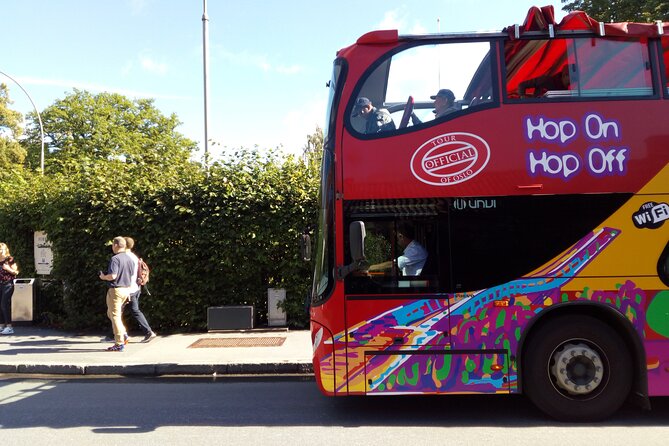
Stops 6 and 7 serve the Hjortnes and Filipstad cruise areas. These are especially useful if you are arriving on a cruise ship. The bus can meet you near the port and take you toward the city center without arranging a separate transfer.
Stop 8 at Tjuvholmen offers a different side of Oslo. This waterfront district is known for modern architecture, galleries, and access to the harbor area. It is listed as an alternative stop, so confirm that the bus is using it on your operating day.
Cruise timing changes the feel of this tour. When several ships arrive, buses can fill quickly, and you may have to wait for the next one. In poor weather, that wait is less pleasant, and the upper deck may be partly enclosed by plastic covers that do not always keep rain out.
If you are visiting Oslo from a ship, build in a generous return buffer. A bus that arrives every 30 minutes on paper may not feel frequent when the first vehicle is full or skips a stop.
Stops 9 through 11: Akershus Fortress, Vippetangen, and Langkaia
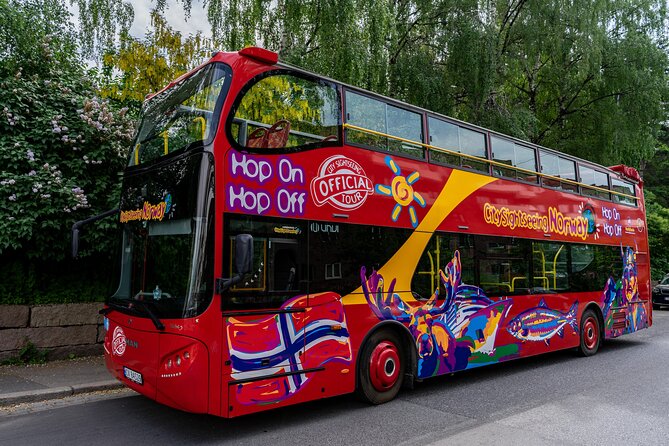
Stop 9 at Oslo Cruise Ship Terminal is close to Akershus Fortress. The fortress is one of the city’s most atmospheric sights, with defensive walls, historic buildings, and views toward the harbor. The bus drops you near the area, but admission to any interior attractions is not included.
Stop 10 at Vippetangen serves Oslo’s ferry port and the Go Nordic Cruiseline connection. This is more of a transport stop than a major sightseeing stop, but it can be useful if you are combining the bus with a ferry journey.
Stop 11 at Langkaia, near Narvesen Havnelageret, puts you along the central waterfront. This area leads toward the Opera House and the harbor promenade. It is a good place to leave the bus and continue on foot if the weather is pleasant.
The harbor section is also where I would be cautious about relying on the recorded narration alone. Some rides have had gaps, static, low volume, or commentary that did not match the view outside. Use the bus as transport first, and treat the audio as a bonus rather than your only source of information.
Stops 12 and 13: The Opera House, MUNCH, and the return to central Oslo
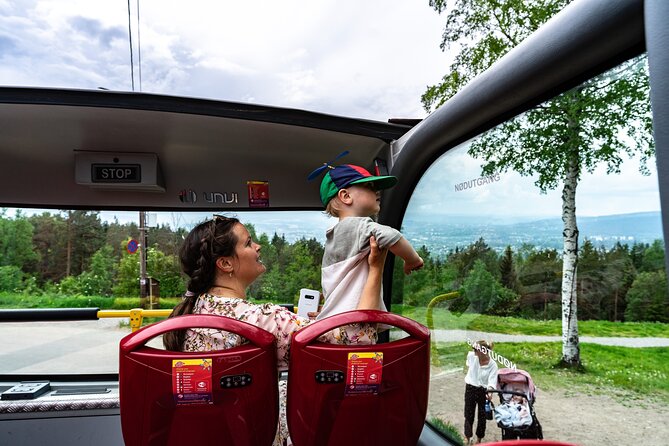
Stop 12 at Operagata 4 serves the Oslo Opera House and the MUNCH Museum. The Opera House is a striking modern building that you can walk across from the waterfront, offering broad views over the harbor. The MUNCH Museum focuses on Edvard Munch, Norway’s best-known painter.
This is a useful final sightseeing stop because the Opera House and MUNCH are close to one another. You can visit one, walk around the waterfront, then catch a later bus back toward the National Theatre.
Stop 13 returns to the National Theatre, Royal Palace, and Karl Johans Gate. The route then completes its circuit. If you stay aboard, you get a second look at the central sights, but the short operating day means you should not assume there will be time for many full loops.
Audio, Wi-Fi, and what the ride feels like
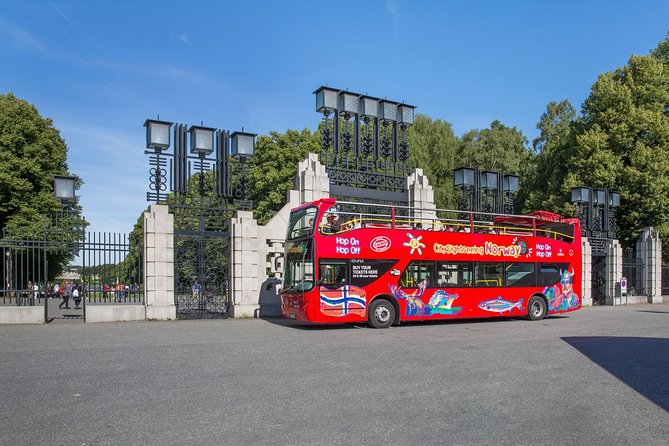
The tour includes recorded commentary in eight languages and free headphones. There are two audio arrangements: in-seat modules and a bring-your-own-device option. Borrowable headsets and adapters are available, but bring your own headset if you plan to use your phone.
Audio quality is the weakest part of the experience. You may find that one bus has clear sound while another has static, dead sockets, poor volume control, or long silent stretches. On some buses, the language channel is not clearly marked, so ask the driver or staff before settling into your seat.
The commentary may also fall out of sync with the sights. That is frustrating if you are trying to photograph a building as it is described. I would keep the route map open, note the stop names, and use the bus mainly to move between areas.
Wi-Fi is included, but its reliability has also varied. Do not depend on it for essential navigation or tickets. Download anything important before boarding.
Weather, seating, and safety
Oslo’s weather can change quickly, and the buses operate in all weather. Dress for wind and rain, even in summer. The upper deck gives the best view, but plastic rain covers can make it less comfortable in wet conditions. Some passengers have reported loose or damaged coverings, so do not try to repair them yourself.
The lower deck is the safer bet in heavy rain, but seats can fill after cruise ships arrive. If you need a seat or are traveling with children, boarding at the first stop gives you a better chance of choosing one.
Most people can participate, and the buses are near public transportation. Still, the service is not a private guided tour. You get a recorded program, a shared bus, and a route that can be affected by traffic and port crowds.
Is $46.60 a fair price?
At $46.60 per person, this tour can be good value if you use it as transportation between several paid sights. Bygdøy alone can take a full day, and the bus saves you from arranging separate connections between the city center, Frogner Park, and the museums.
The value is weaker if you only stay aboard for one 90-minute loop. In that case, you are paying mainly for a broad introduction and the convenience of an open-top bus. If the audio fails or the vehicle is delayed, the price feels harder to justify.
The 48-hour option makes the most sense for a relaxed visit, provided your schedule overlaps with the operating hours. A 24-hour pass works well for a focused day that includes Bygdøy and one or two central stops.
Free cancellation is available up to 24 hours before the scheduled start time. Mobile and printed vouchers are accepted, but you must exchange the voucher with City Sightseeing staff or the driver before or upon boarding. Keep the ticket with you.
Who should book this Oslo bus tour?
I would consider it for a first visit, a short port call, a rainy day, or anyone who wants to combine Oslo’s museums without learning the local transport system. It is also helpful if walking long distances is difficult, since the route links several separated areas.
I would be more cautious if your schedule is tight, especially around a cruise departure. Delays, full buses, skipped stops, and weak audio can turn a short sightseeing plan into a long wait. Oslo’s public transport may be a better choice if you need precise timing, but this tour has the advantage of stopping near the main attractions.
Should you book it?
Book this tour if you want a simple overview and plan to use the bus for at least two or three stops, especially Bygdøy, Vigeland Sculpture Park, Akershus Fortress, or the Opera House. The route is useful, the museum connections are practical, and the 24 or 48-hour format gives you some freedom.
Skip it if your main goal is a polished guided experience or a dependable schedule. The route itself is worthwhile, but the audio and operations have been inconsistent. For the best result, ride the full loop early, choose your stops carefully, carry a backup route on your phone, and leave plenty of time before any ship departure.
FAQ
How long is the full Oslo hop-on hop-off route?
The full loop takes approximately 90 minutes when you stay aboard.
How often do the buses run?
The scheduled frequency is every 30 minutes. Actual waits can be longer because of traffic, crowded buses, skipped stops, or operational delays.
What time does the first bus leave?
The first departure from Stop 1 at the National Theatre is at 10 a.m.
What time is the last departure?
The last departure from Stop 1 is at 4 p.m.
Can I use the bus for 24 or 48 hours?
Yes. You can choose a 24-hour or 48-hour hop-on hop-off ticket.
Where is the first stop?
Stop 1 is at the National Theatre on Karl Johans Gate, near the Royal Palace and central Oslo.
Does the route stop near the cruise port?
Yes. Stops serve Oslo Cruise Ship Terminal, Hjortnes, and the Royal Caribbean and MSC cruise gate area at Filipstad.
Are museum and attraction admissions included?
No. Entrance fees for attractions are paid separately.
Is audio commentary included?
Yes. Recorded commentary is offered in eight languages, and free headphones are included. You can also use the BYOD option with your own device and headset.
Does the tour operate year-round?
No. It is seasonal and typically operates from June through October, with dates varying each year. It does not run on May 17.
Just added in Oslo
- Akerselva River: Urban Paddling Adventure Kayak Tour★ 4.3 · 29 reviews
- Oslo Sea Kayak Tour “Fjord City”★ 4.5 · 39 reviews
- Oslo: Historic Myths & Legends Evening Walking Tour★ 4.8 · 408 reviews
- Oslo: Guided Walking Tour of Central Oslo★ 4.7 · 438 reviews
- Oslo: Sightseeing with Holmenkollen Ski Jump & Vigeland Park★ 4.5 · 451 reviews
- Oslo: Best of Oslo Walking Tour★ 4.5 · 458 reviews
- The Fram Museum Admission Ticket★ 4.5 · 490 reviews
- Oslo: Fjord Mini Cruise by Wooden Sailing Ship★ 4.5 · 503 reviews
Hop-On Hop-Off Bus Tours, compared.
24 or 48-Hour Hop-On Hop-Off Sightseeing Bus Ticket
Read our review →
Hop-On Hop-Off Bus and Perlan Museum Entry Ticket
Read our review →
Grand City Sightseeing Tour by Bus with Fjord Cruise
Read our review →
Browse the lists this tour appears in